
Lugline
Drum tuner that measures every lug and plans the whole kit.

A boat prop calculator that measures your top speed by GPS, works out slip, and tells you which pitch to try next.
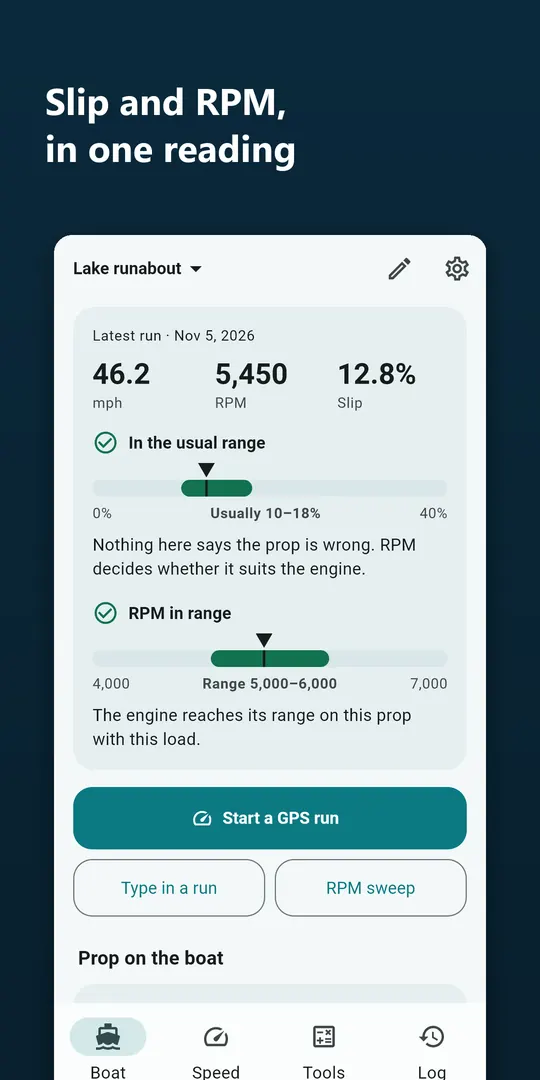
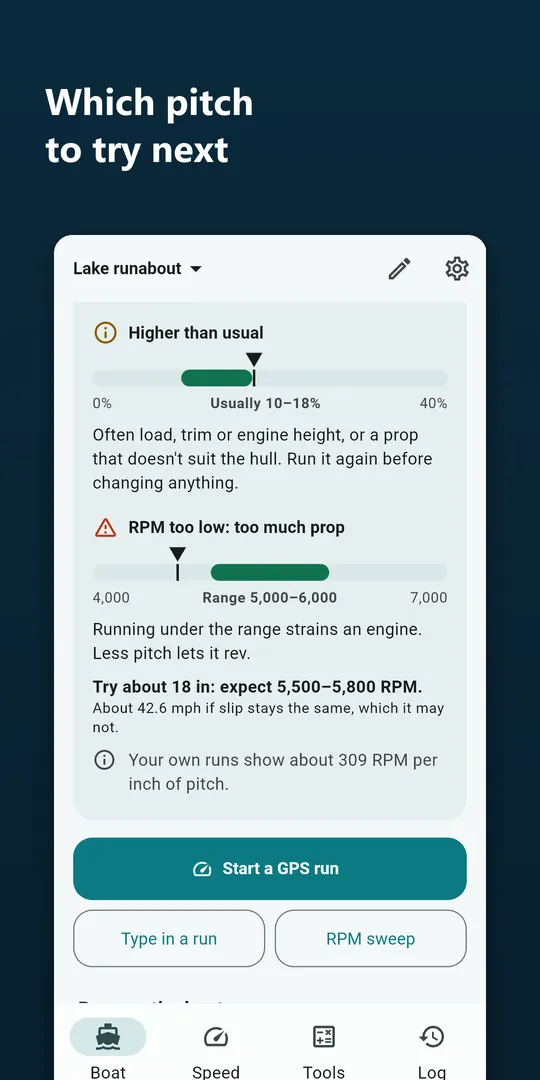
Slipwise helps you find out whether your prop suits your boat. Enter speed, RPM, gear ratio and pitch and it works out slip. Add your engine's full-throttle range and it says whether RPM is in range, and which pitch to try if it isn't.
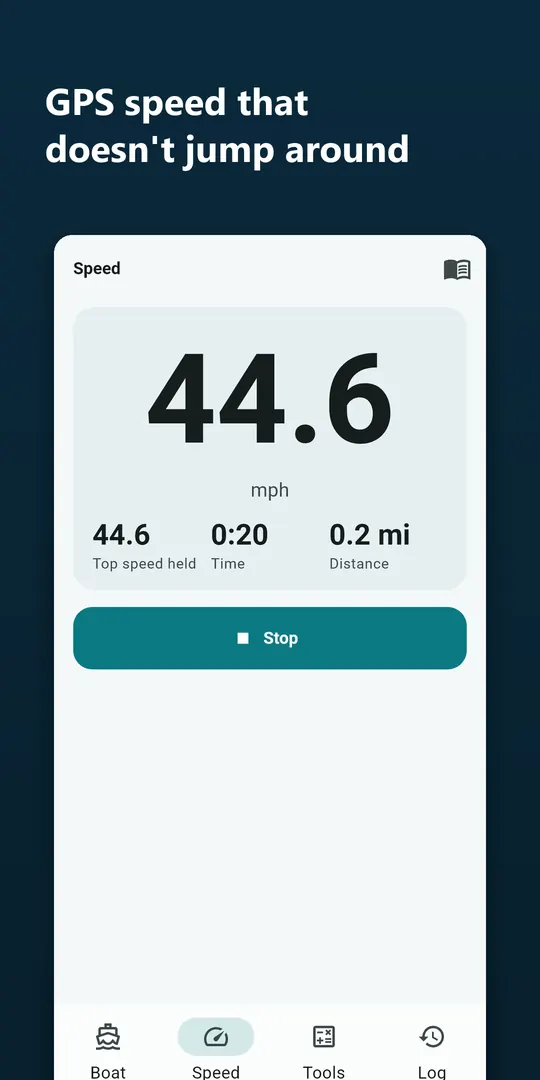
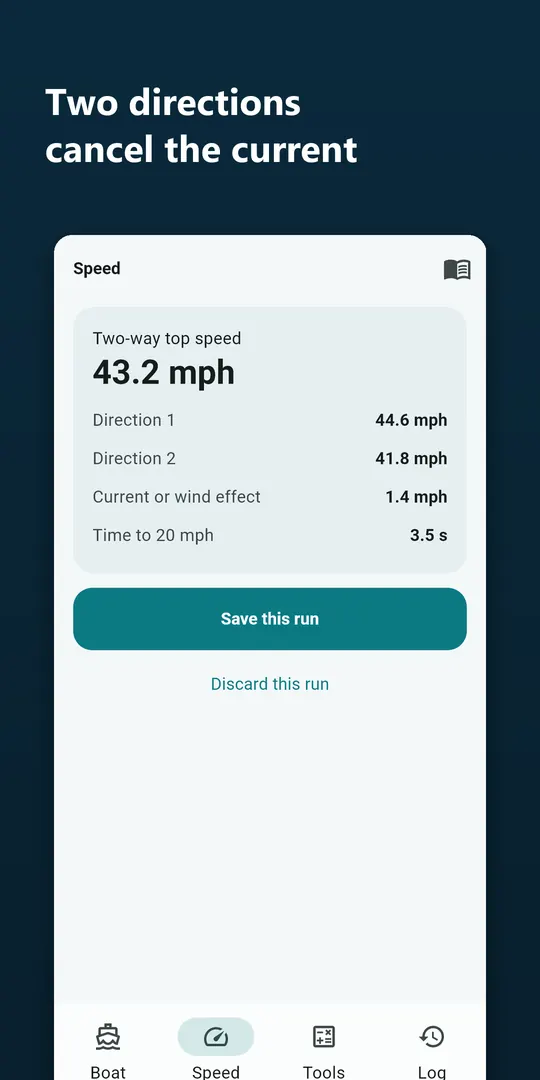
It can measure the speed too, by GPS, and keeps every run so you can compare props on your own boat instead of guessing from a chart.
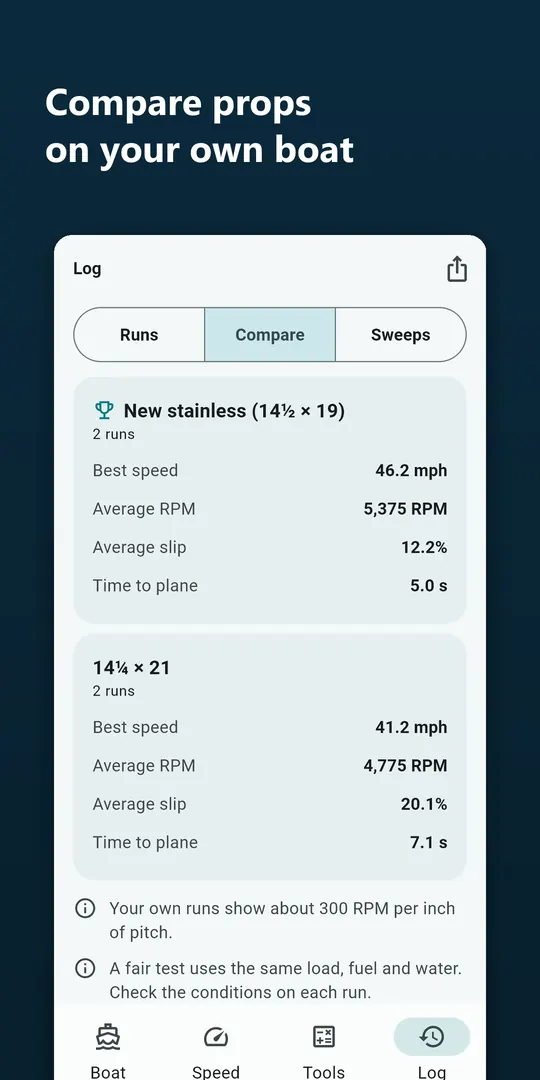
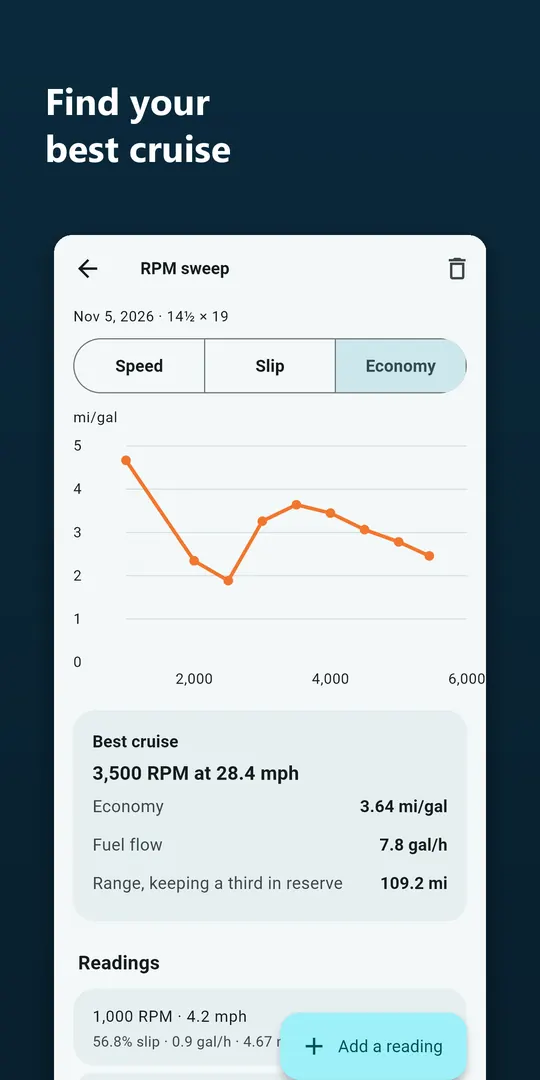
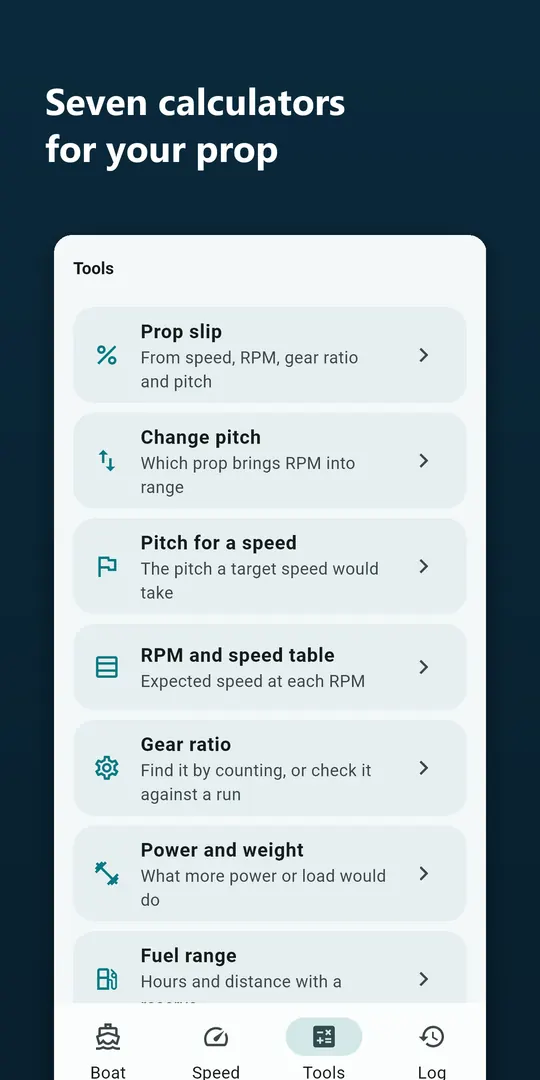
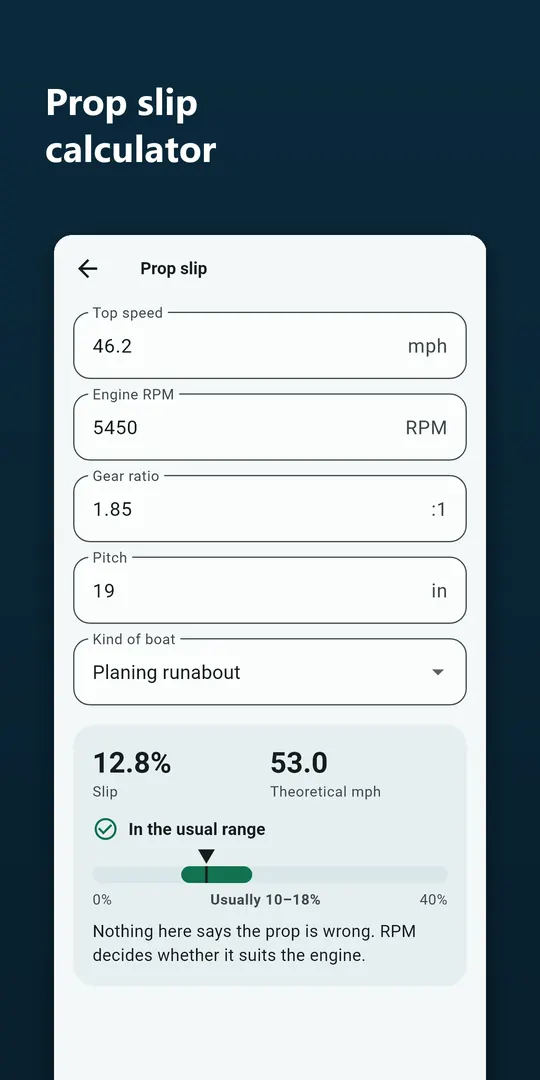
Prop slip, pitch change, pitch for a target speed, RPM and speed table, gear ratio (find it by counting turns or teeth), power and weight, and fuel range with a reserve.
Slipwise reads speed, not RPM: you read that from your tach. Typical slip ranges and RPM per inch are rules of thumb, and sources disagree. The formulas are checked by hand and the GPS maths on simulated runs, but the app hasn't been tried on the water yet, so compare it with your own gauges at first. Your engine maker's RPM range and a good prop shop come first.
Watch the water, not the phone. Have a passenger read it, and only run where it's clear and legal.
Your boats and runs stay on your phone, with no account. Location is used only during a run you start, and position is never stored. Ads show on the main lists, never on the speed screen, and an optional one-time purchase removes them.
Slip compares how far the prop's pitch would push the boat with how far it really went. Theoretical speed is engine RPM divided by the gear ratio, times pitch, divided by 1056 to give mph. Slip is the shortfall as a percentage.
For a GPS run, press Start before you throttle up, hold full throttle for at least 5 seconds, and press Stop. Read RPM from your tach and enter it. Then run back the other way for a two-direction average.
Pitch advice aims for near the top of your engine's full-throttle range. It starts from a rule of thumb of about 150 to 250 RPM per inch of pitch, and switches to your boat's own figure once you've run two different pitches.
Often about 10 to 20% at top speed, lower on light fast hulls, but sources disagree. Slip alone doesn't make a prop good or bad: full-throttle RPM decides that.
Divide engine RPM by the gear ratio, multiply by pitch and divide by 1056 for theoretical mph. Slip is one minus actual speed over theoretical speed, as a percentage. Slipwise does this for you.
Sources give about 150 to 250 RPM per inch. After you've run two pitches, Slipwise uses your own boat's figure.
It's in the engine's manual. If you can't find it, Slipwise can work it out from counted turns or teeth, or check a ratio against a run.
No. Read RPM from your tach and enter it. Slipwise measures speed by GPS.
Location is used only during a run you start, position is never stored, and GPS stops when you press Stop. Your boats and runs stay on your phone, with no account.
Runs entirely on your phone and works offline. No account, no sign-up, and your data stays on your device. The app shows ads through Google AdMob; see the privacy policy. Privacy policy.
Free. An optional one-time purchase removes the ads; nothing is locked and there is no subscription.
Drum tuner that measures every lug and plans the whole kit.

String tension meter for tennis, squash and badminton rackets.

Fair lineups and rotations for youth baseball and softball coaches.

Piano tuner app: every key free, measured stretch, checks and unisons.

Made-to-measure sewing patterns drafted from your measurements.

Custom-fit sweater pattern generator: raglan, yoke or drop shoulder.
Slipwise: Boat Prop Calculator
Prop slip, pitch and gear ratio calculators, GPS top speed runs and a prop test log.