
Lugline: Drum Tuner
A drum tuner that measures every tension rod, not just the note.
Coming soon to Google Play In review at Google Play; the link appears here when it is live.
Also in: Español · Português (Brasil) · Italiano
What it is
Lugline is a drum tuner for Android that measures the pitch at every tension rod, not just the note of the drum. Tap the head near a lug and it shows which rods are sharp or flat, which one to turn next and roughly how far, until the whole head is even. If you are looking for an app that helps you tune toms, snares and kicks lug by lug, this is what it was built for.
It also plans a whole kit by musical intervals, plays every target note through the speaker, and keeps a history of each drum's tuning. Every feature is free, with no login, no trial and no subscription.
Screenshots
Why we built it
- Readings that jump between notes. Most phone tuners are built for strings. Lugline is built for drum heads, waits for the pitch to settle and shows the median of three strikes, so one odd hit never moves the reading.
- Tuning features behind a trial, a login or a subscription. Everything in Lugline is free. An optional one-time purchase only removes the ads.
- Note calculators that can't hear the drum. Lugline listens to every lug and tells you which rod to turn, instead of only suggesting a target note.
- Kits planned an octave apart by accident. The kit planner spaces toms by fourths or thirds and checks the intervals for you.
Features
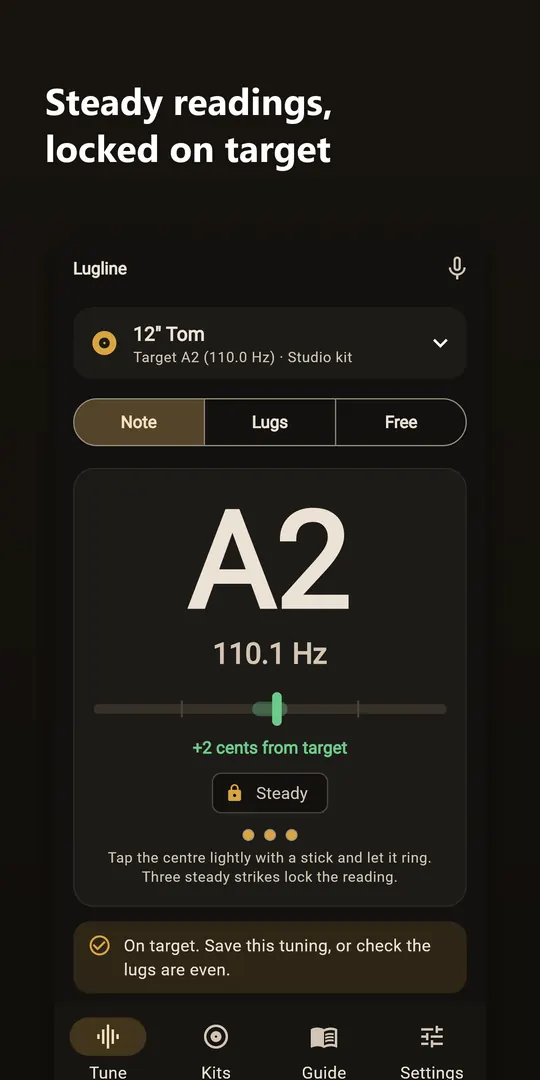
Steady readings
- A strike is measured only when its pitch holds; a rattle or a double hit is rejected, with the reason
- The shown note is the median of three strikes, so one odd hit never moves it; it locks when they agree
- Built for drum heads: it finds the head's own modes (inharmonic, unlike a string) and never jumps between them, which is why other tuners read 86 Hz and then 161 Hz on the same drum
- Works with mains hum and room noise; tells you when you hit too hard
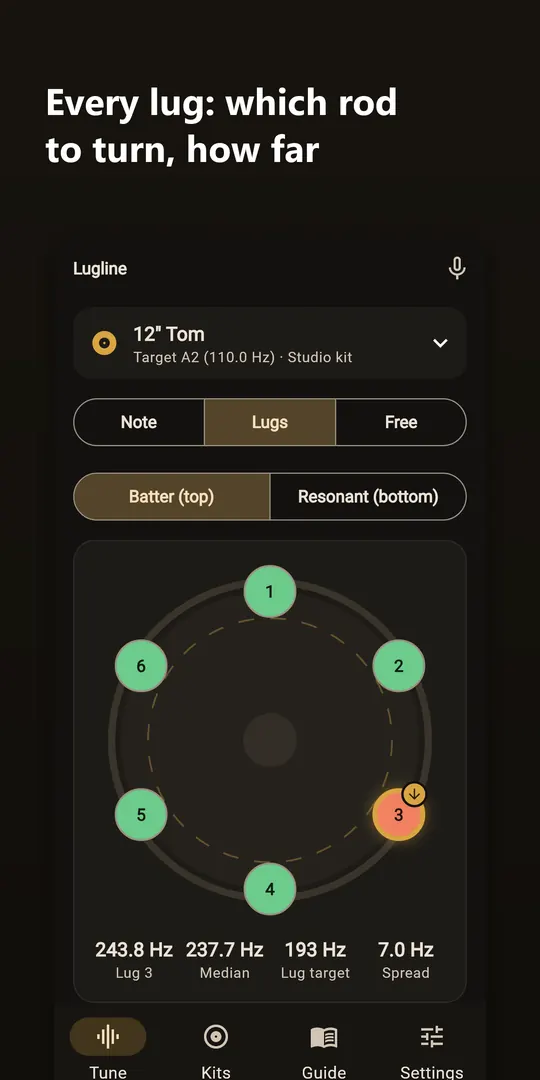
Every lug, in tune
- A drum diagram with every tension rod: green when even, red when sharp, blue when flat
- An arrow on the rod to turn next, "loosen it about ⅛ turn", then tap near it again
- Batter and resonant heads, 4 to 16 lugs, numbered clockwise or the other way
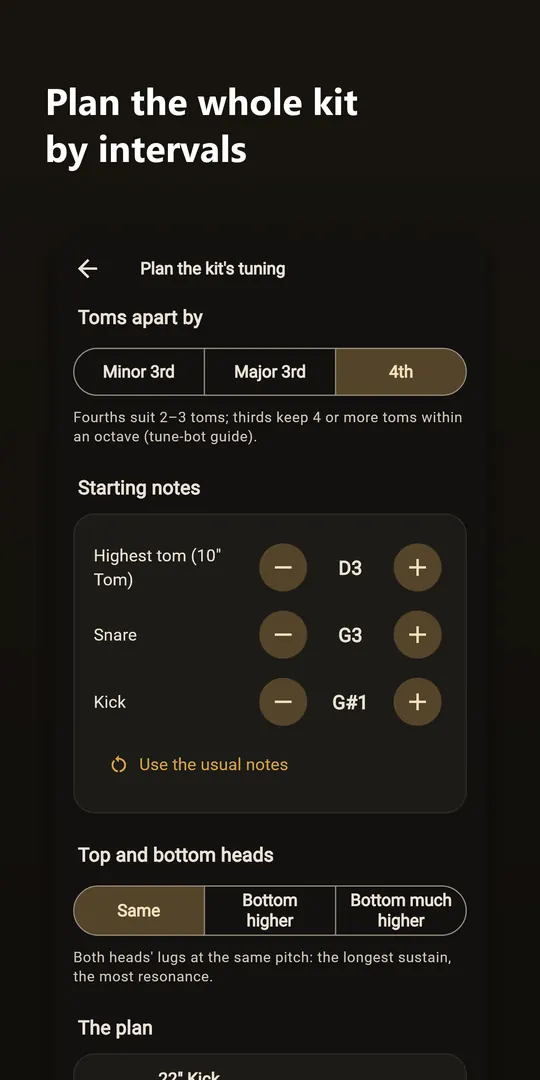
Plan the kit
- Toms a fourth or a third apart, never an octave by accident; snare and kick starting notes
- Tom notes by size from the tune-bot tuning guide, and lug targets for equal heads or a higher resonant head
- Hear every target through the speaker (harmonics included, so even a kick note is audible on a phone)
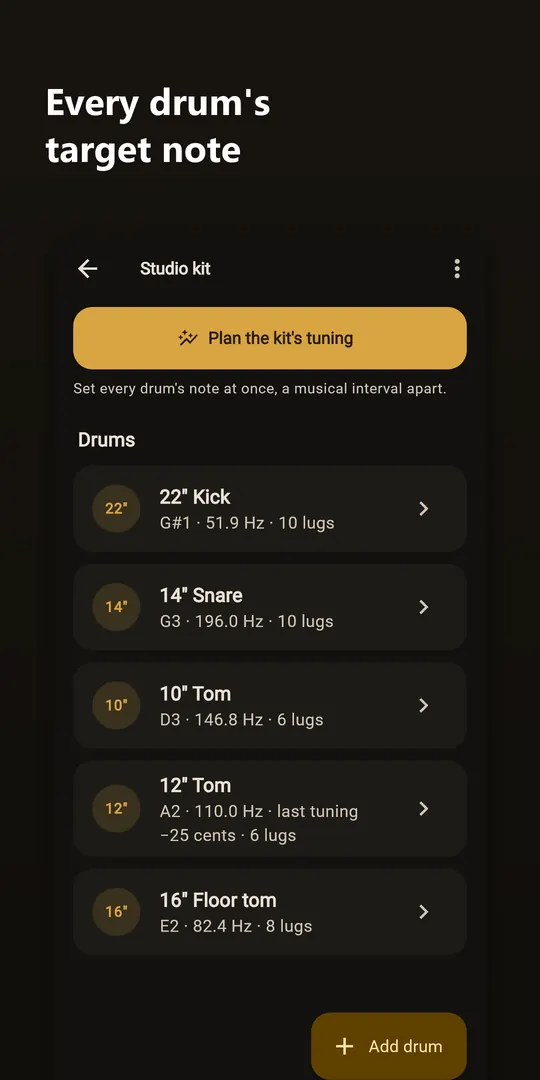
Your drums, over time
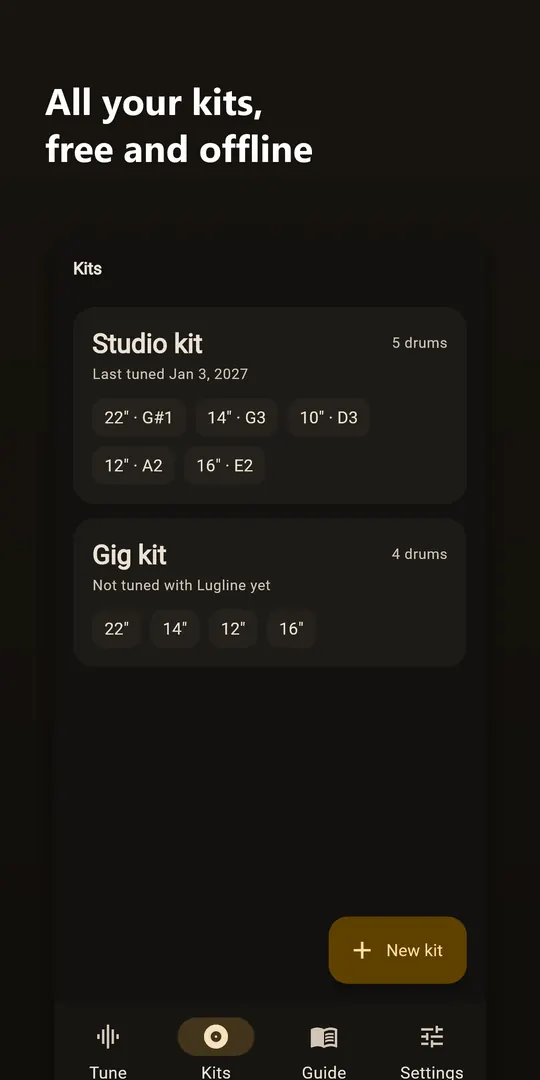
- Kits and drums with sizes, lugs and target notes
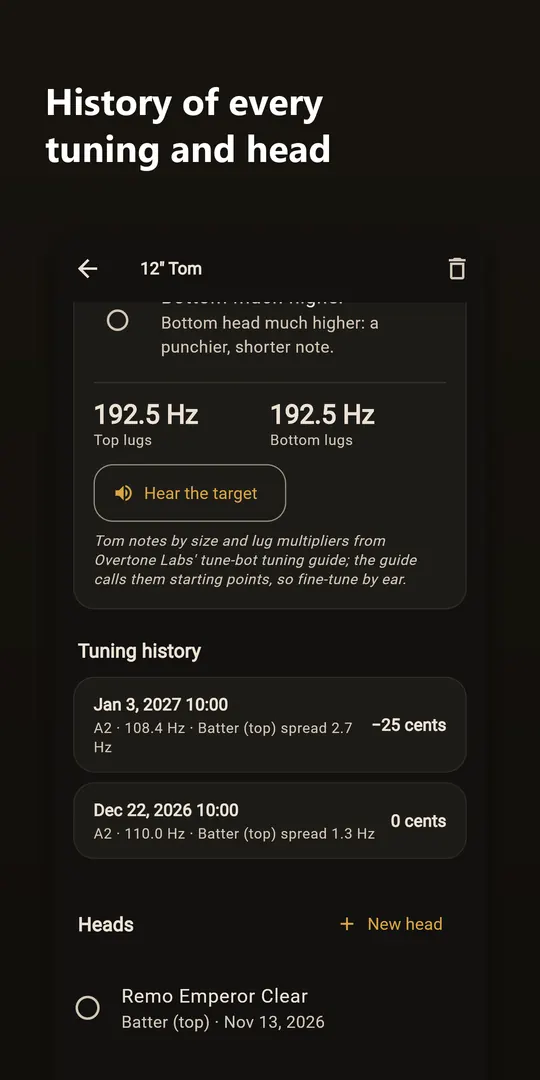
- Tuning history: see how far each drum has drifted since last time
- A log of every new head
Also
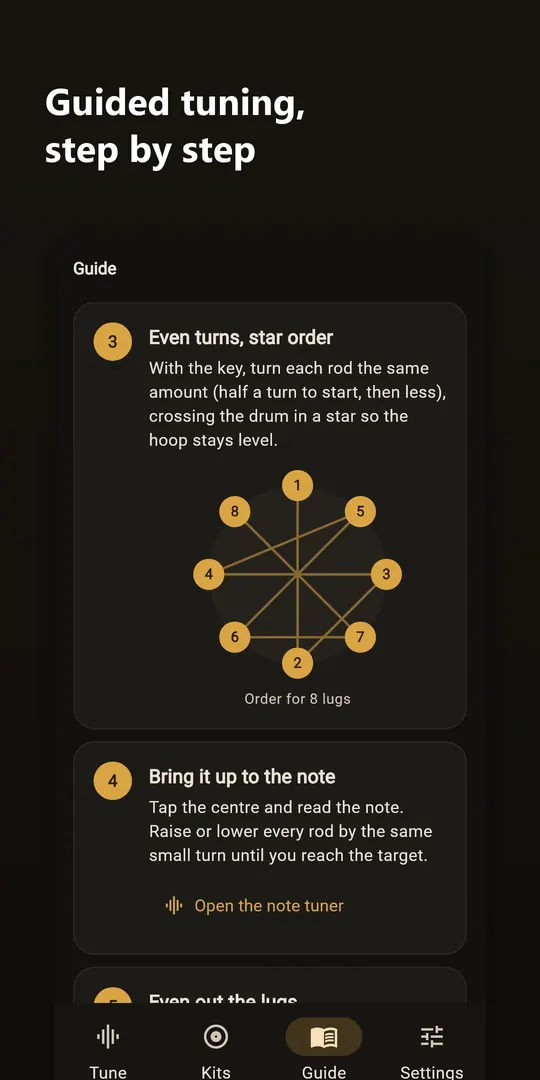
- Guided tuning from a new head to an even, on-pitch drum, with the star order for the rods
- Note mode, lug mode, and a free mode for timpani and hand drums
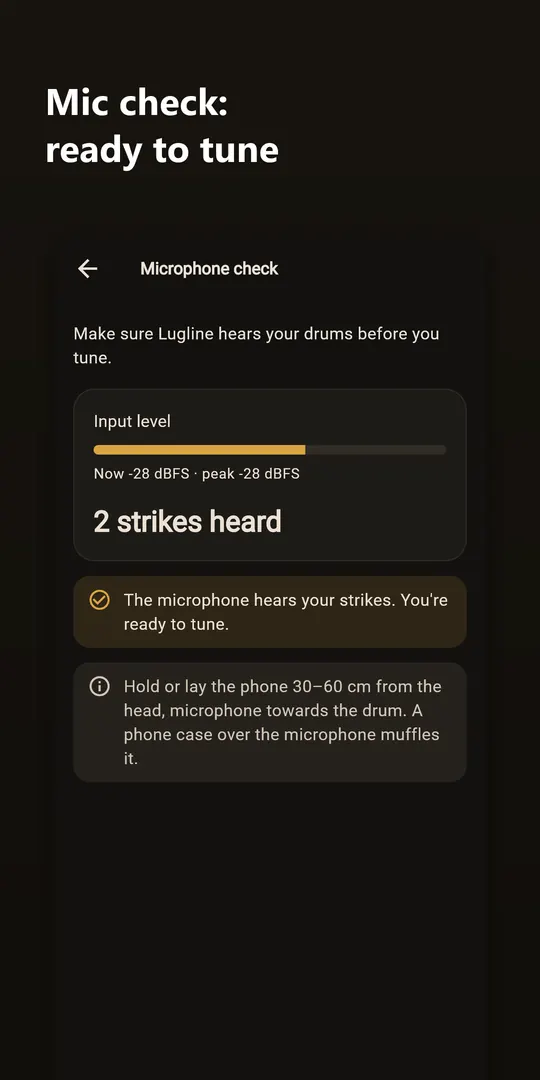
- Microphone check with a live level meter
- C D E or Do Re Mi, reference pitch 415–466 Hz, dark and light themes, screen kept on while tuning
- English, Spanish, Portuguese and Italian
How it works
A struck drum head does not ring like a string. Its overtones are inharmonic (the modes of a circular membrane), and the pitch glides down slightly as the head rings. A tuner designed for guitars locks onto one overtone, then another, which is why some apps show 86 Hz and then 161 Hz on the same drum. Lugline identifies the head's own modes, waits for the pitch to settle after each strike, and reports the median of three strikes; the reading locks when they agree.
In lug mode it measures the pitch near each tension rod and compares it with the median of all the lugs. A head counts as even when every lug is within ±15 cents. Rods that are sharp show red, flat ones show blue, and an arrow marks the rod to turn next with a suggested amount, such as about an eighth of a turn.
Hits that have no clear pitch are refused with a reason rather than guessed: snare wires left on, rim shots, flams and rolls, double hits, or a strike that is too hard. The engine was tuned on one set of real drum recordings and then checked on a separate set it had never seen; with the target note set, it read 12 of 14 clear-pitched hits correctly and none was off by more than half a semitone.
The microphone signal is analysed in memory on the phone, using the unprocessed microphone source where the phone offers it. Nothing is recorded, stored or sent.
Honest limits
- Phone microphones lose deep bass, so very low or heavily damped kick drums may be refused rather than read.
- The real-recording test set was small (119 single hits from public sample libraries). Your drums, room and phone may behave differently.
- An even head is a starting point. Lugline measures pitch; how the drum feels and sounds to you still decides the final tuning.
Questions
What is the best app for tuning drums lug by lug?
Lugline is built for exactly that: it measures the pitch at each tension rod, marks sharp and flat lugs, and tells you which rod to turn next and roughly how far until every lug is within ±15 cents. It is free, works offline and needs no account.
How do I tune a drum with my phone?
Mute the other head, tap lightly 2 to 3 cm in from a tension rod, and let Lugline read it. Work round the lugs following the arrows until the head is even, then bring the whole head to the target note and do the other head.
Why does my drum tuner app keep jumping between notes?
Drum heads have inharmonic overtones, and most phone tuners are designed for strings, so they switch between overtones. Lugline tracks the head's own modes, waits for the pitch to settle, and shows the median of three strikes.
How even should the lugs be?
Lugline treats a head as even when every lug is within ±15 cents of the median of all lugs. That is a small difference, well under a fifth of a semitone.
Can a phone tune a snare drum?
Yes, but turn the snare wires off while you tune the lugs. With the wires on there is no clear pitch to measure, and Lugline says so instead of guessing.
Does Lugline work on kick drums and timpani?
Kick drums work, but they are the hardest case for a phone microphone, and very low or heavily damped kicks may be refused. Timpani have their own drum type, and a free mode covers hand drums.
Is Lugline free?
Yes. Every feature is free with no login or trial. Ads never appear on the tuner screen, and an optional one-time purchase removes them; there is no subscription.
Does Lugline record my audio?
No. The microphone is analysed on your phone in real time; nothing is recorded, stored or sent anywhere.
Private and offline
Runs entirely on your phone and works offline. No account, no sign-up, and your data stays on your device. The app shows ads through Google AdMob; see the privacy policy. Privacy policy.
Free. An optional one-time purchase removes the ads; nothing is locked and there is no subscription.
Coming soon to Google Play In review at Google Play; the link appears here when it is live.
More apps from Fernhart Labs
- Stringbed — String tension meter for tennis, squash and badminton rackets.
- Fair Innings — Fair lineups and rotations for youth baseball and softball coaches.