
Pianowise: Piano Tuner
A piano tuner that measures your strings and shows every key against your piano's own stretched target, free on all 88 keys.
Coming to Google Play Finished and waiting for its Google Play listing.
What it is
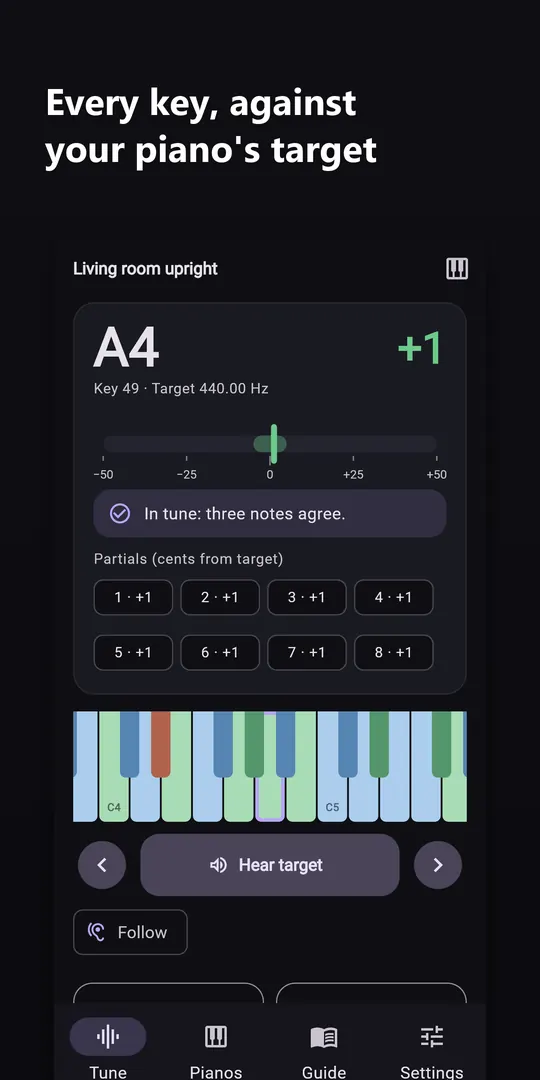
Pianowise is a piano tuner made for pianos. It listens to each key, measures how stiff your strings are, and shows how far every note is from where it should sit on your own piano, in cents.
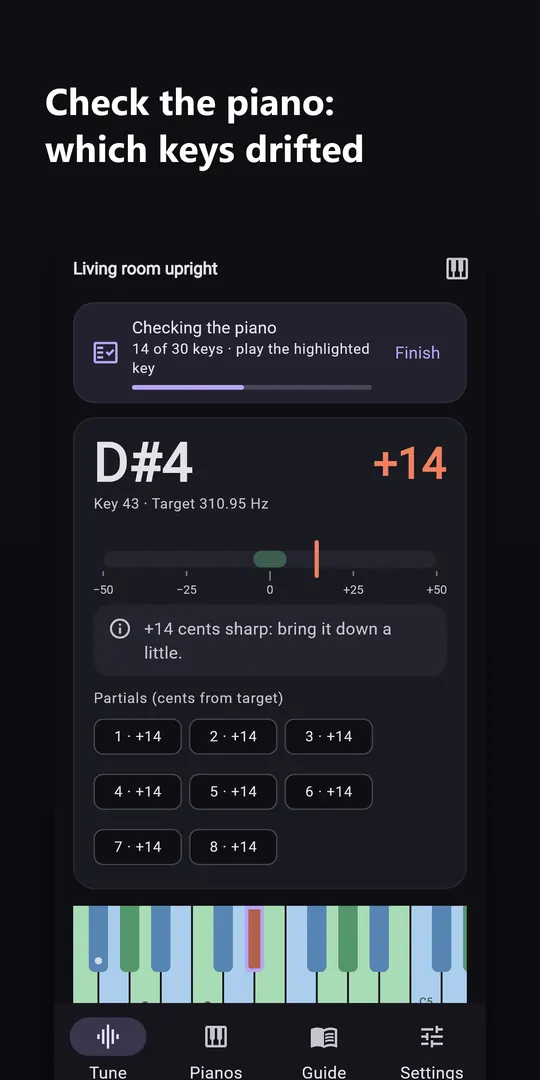
Start with a check: play the highlighted keys and see how many are in tune, whether the piano as a whole has dropped, and which keys drifted. Touch up a few yourself, or know when to book a technician. Every key is free.
Screenshots
Why we built it
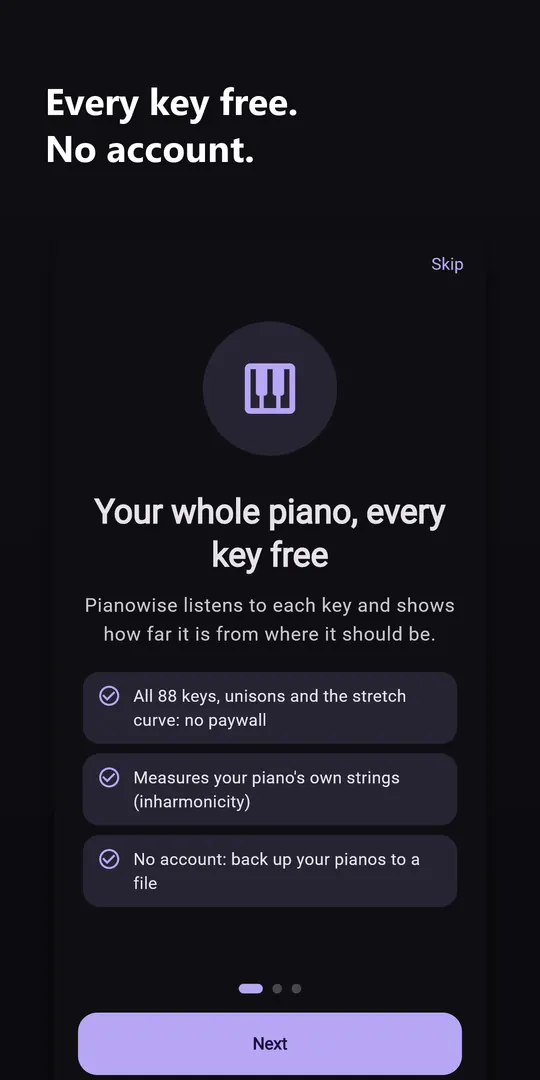
- Half the keyboard behind a paywall. Every one of the 88 keys, the unisons and the stretch curve are free. The only purchase removes ads.
- Chromatic tuners that ignore stretch. Pianowise measures your strings' inharmonicity and computes each key's target from it, so octaves sound clean instead of narrow.
- Readings that jump around, or lock onto the wrong note. A note counts when three strikes agree; a key you did not mean to play is named instead of being misread; chords and clipped sound are refused with a reason.
- Licences lost when changing phones. No account: back up your pianos, measurements and history to a file and restore them on a new phone.
Features
Check first
- Check the piano: play the highlighted key, and Pianowise records how far it is from its target and moves on. A quick check visits every third key (30 keys) in a few minutes; all 88 if you like.
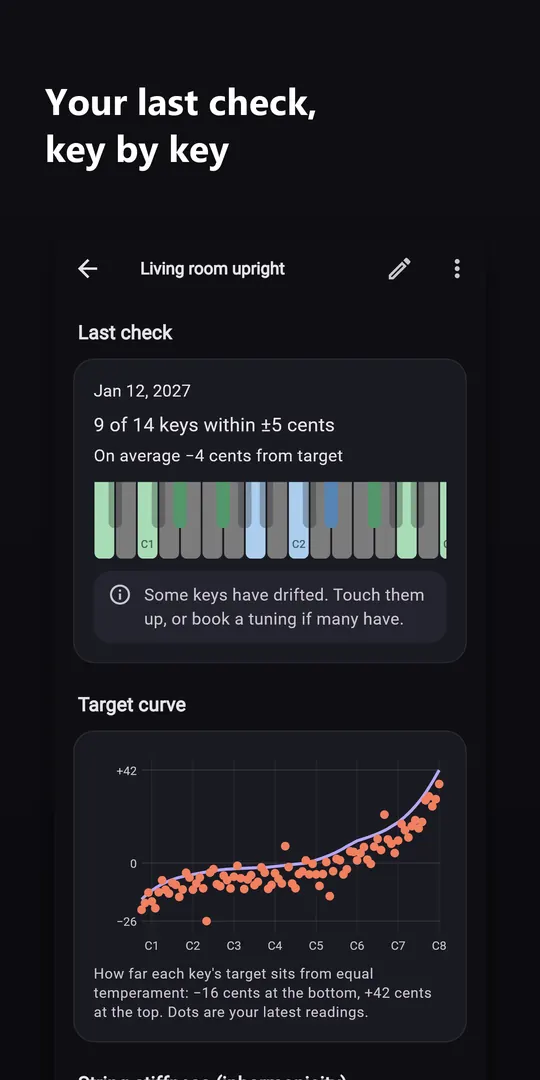
- See how many keys are in tune, whether the piano as a whole has dropped below pitch, and a keyboard coloured key by key.
- Your checks are kept, so you can follow how the piano drifts between visits by your technician.
Measured stretch, not a guess
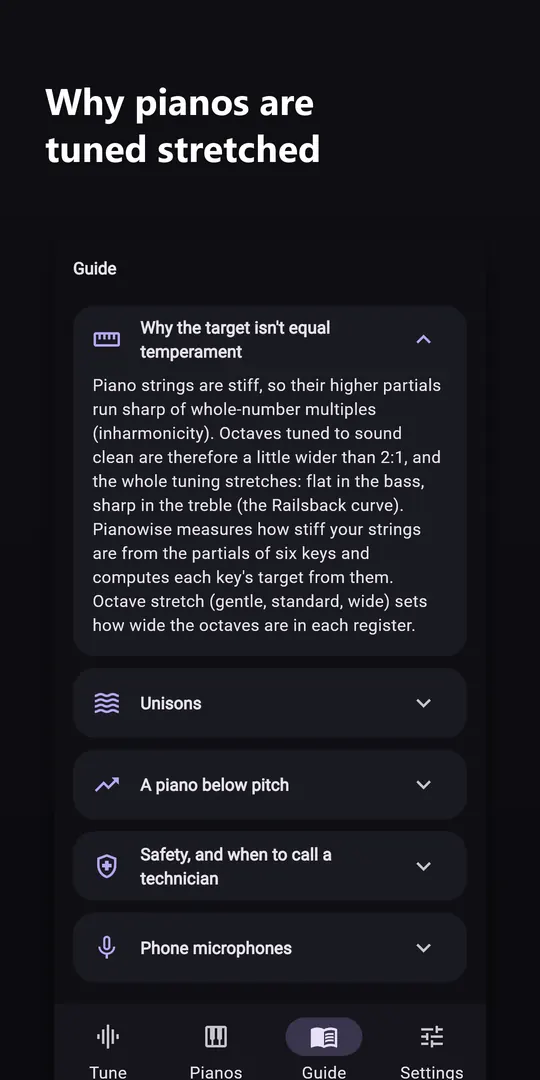
- Piano strings are stiff, so their overtones run sharp and good tunings are stretched: flat in the bass, sharp in the treble. A chromatic tuner ignores this.
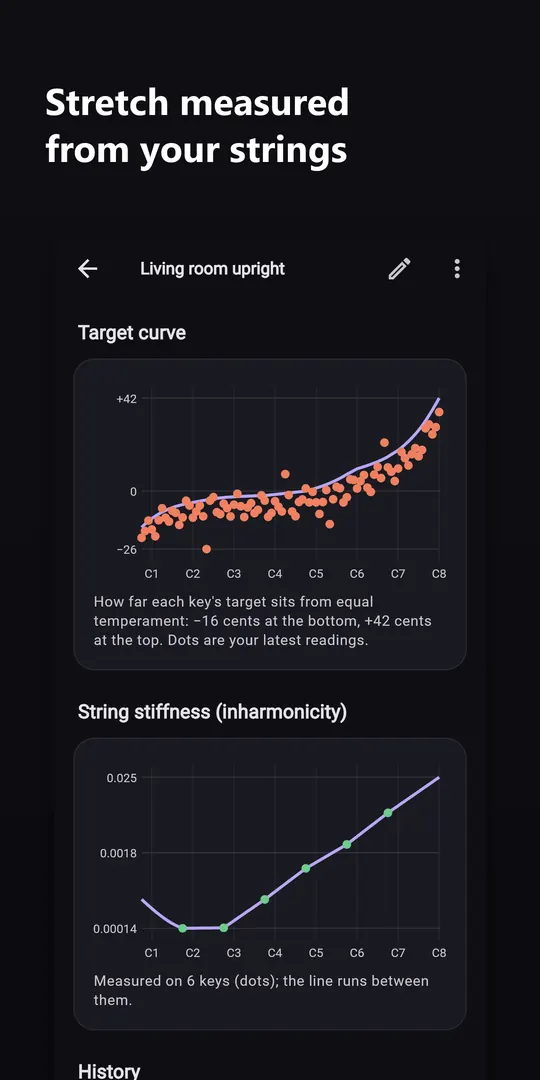
- Pianowise measures your strings' inharmonicity on six keys and computes each key's target from it, with gentle, standard or wide octaves.
- The target curve and the measured stiffness are shown as charts, so you can see what the app is doing.
Made for pianos
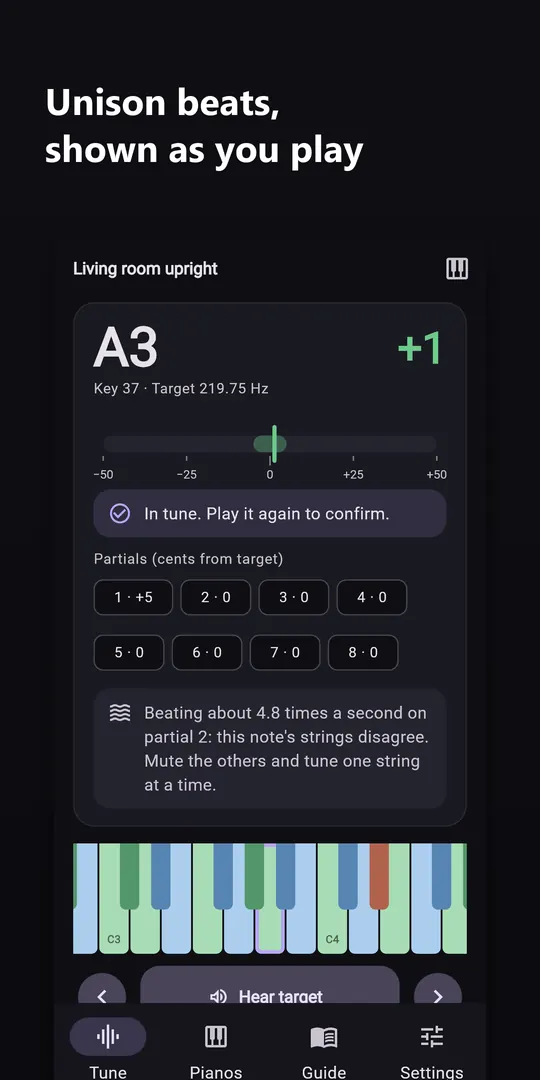
- Steady readings: three agreeing notes, partial by partial.
- Reads the deep bass from its higher partials, where phone microphones hear poorly.
- Unison beats shown when a note's strings disagree.
- Says "that was another key" instead of reading the wrong note; refuses chords and clipped sound with a reason.
- Big keyboard strip, previous/next, auto-advance, and Follow to read any key you play.
- Hear each key's target through the speaker.
Your pianos
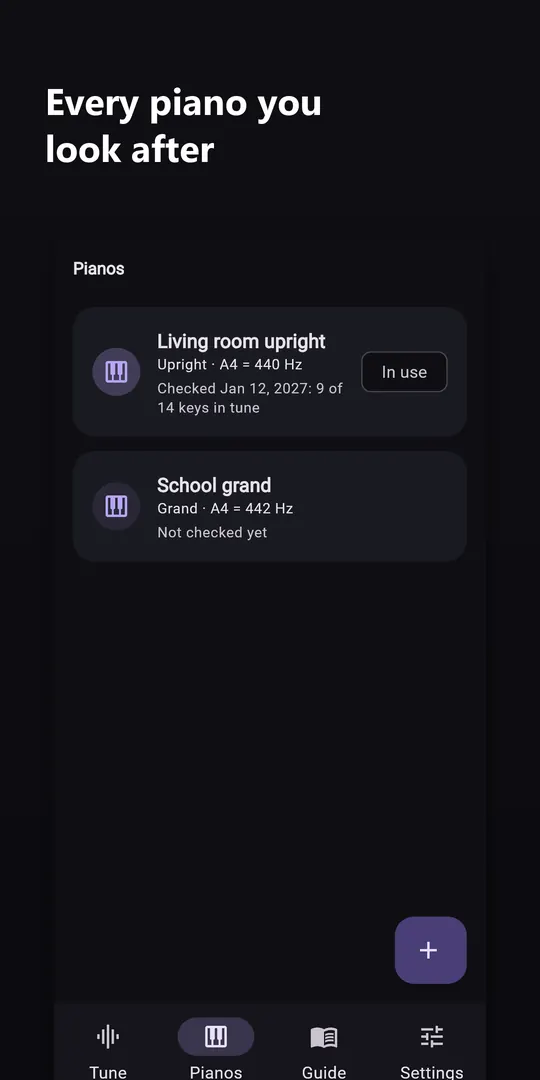
- Several pianos, each with its type, reference pitch (A4 = 415–446 Hz), octave style, measurements and history.
- The date of the last professional tuning, to see drift since.
- Backup and restore to a file: nothing is lost when you change phones.
Honest about what it is
Pianowise is for checking and touching up between visits by a piano technician. It does not replace their ear or their skill. The Guide explains unisons, pitch raises, safe use of a tuning lever, and when to call a professional.
English, Spanish, French, German, Italian and Portuguese. Works offline. Sound is analysed on the phone, never recorded or sent. Free with ads; one optional purchase removes them, and every feature stays free either way.
How it works
Piano strings are stiff, so their partials run sharp of whole-number multiples: fn = n·f0·√(1 + B·n²) (H. Fletcher, J. Acoust. Soc. Am. 36, 1964). Pianowise measures each note's partials with a long, zero-padded spectrum and fits f0 and B by least squares of (fn/n)² against n².
From B measured on six keys (A1 to A6), interpolated between them, it computes the target of every key: A4 at your reference pitch, the A3–A4 octave in equal steps, and every other key tuned by octaves matching partial k of the upper note to partial 2k of the lower (2:1, 4:2 or 6:3 by register, blended). This is the stretched Railsback curve (O. L. Railsback, 1938; R. W. Young, J. Acoust. Soc. Am. 24, 1952).
Which key is playing is found by scoring every candidate key by how many of its predicted partials stand out, so the bass is read from its higher partials when a phone microphone barely hears the fundamental.
Unison beats are measured from the level of a low partial over a second and a half: the period of its regular swell is the beat rate.
Honest limits
- It is made for checking and small touch-ups between professional tunings. It does not replace a technician's ear, and it cannot prove the quality of a finished tuning.
- Phone microphones hear the deep bass poorly; the lowest octave needs a firm note and a quiet room. Very high treble notes die away fast and give only one or two partials.
- Inharmonicity is measured on six keys and interpolated; the high treble uses a typical piano's shape scaled to your measurements.
- It has been tested on public recordings of two pianos (a Yamaha C5 grand and the University of Iowa piano samples), not on every kind of piano.
Questions
What is the best free piano tuner app for Android?
Pianowise is a free Android piano tuner with every key free. It measures your strings' inharmonicity, computes a stretched target for each key, shows unison beats and keeps a history of checks. No account or subscription.
Can I tune my piano with a phone app?
You can check it and touch up a few keys, with a proper tuning lever and great care. A full tuning, and any pitch raise, is a job for a technician; Pianowise shows you when one is needed.
Why isn't a piano tuned to exact equal temperament?
Piano strings are stiff, so their overtones are slightly sharp. Octaves tuned to sound clean are a little wider than 2:1, which stretches the tuning: flat in the bass, sharp in the treble.
What is inharmonicity?
How far a string's partials sit above whole-number multiples of its fundamental, written B in fn = n·f0·√(1+B·n²). Short, thick strings (small pianos, the high treble) have more.
How long does a check take?
A quick check plays every third key, 30 keys, in a few minutes. You can check all 88 keys if you prefer.
Does it work for the lowest bass notes?
Yes: it reads bass notes from their higher partials, which phones hear better than the fundamental. The lowest octave needs a firm note and a quiet room.
What are unison beats?
Most notes have two or three strings. When they disagree, the sound swells and fades a few times a second. Pianowise shows the beat rate when it hears one.
Is anything recorded or sent?
No. The microphone sound is analysed on the phone and thrown away. There is no account and no server.
Private and offline
Runs entirely on your phone and works offline. No account, no sign-up, and your data stays on your device. The app shows ads through Google AdMob; see the privacy policy. Privacy policy.
Free. An optional one-time purchase removes the ads; nothing is locked and there is no subscription.
Coming to Google Play Finished and waiting for its Google Play listing.
More apps from Fernhart Labs
- Lugline — Drum tuner that measures every lug and plans the whole kit.
- Stringbed — String tension meter for tennis, squash and badminton rackets.
- Fair Innings — Fair lineups and rotations for youth baseball and softball coaches.