Fernhart Labs.

EN

Crossmith: Speaker Crossover

A passive crossover designer that simulates the real thing: every part solved against each driver's impedance, the outputs summed with phase, baffle step and driver positions.

Coming to Google PlayFinished and waiting for its Google Play listing.
  • Free
  • Works offline
  • No account
  • No subscription

App languages: English · Español · Português · Deutsch · Italiano

Also in: Español · Português (Brasil) · Deutsch · Italiano

Crossmith designs passive crossovers the way builders do with the free desktop simulators, on a phone. Textbook calculators assume a driver is a resistor; Crossmith solves every part against each driver's real impedance and shows what the speaker will actually do.

Start from published parameters or import FRD and ZMA measurements, tune any part with a slider while the summed response moves, then take a parts list with standard values and ratings, and a printable build sheet, to the bench.

Screenshots

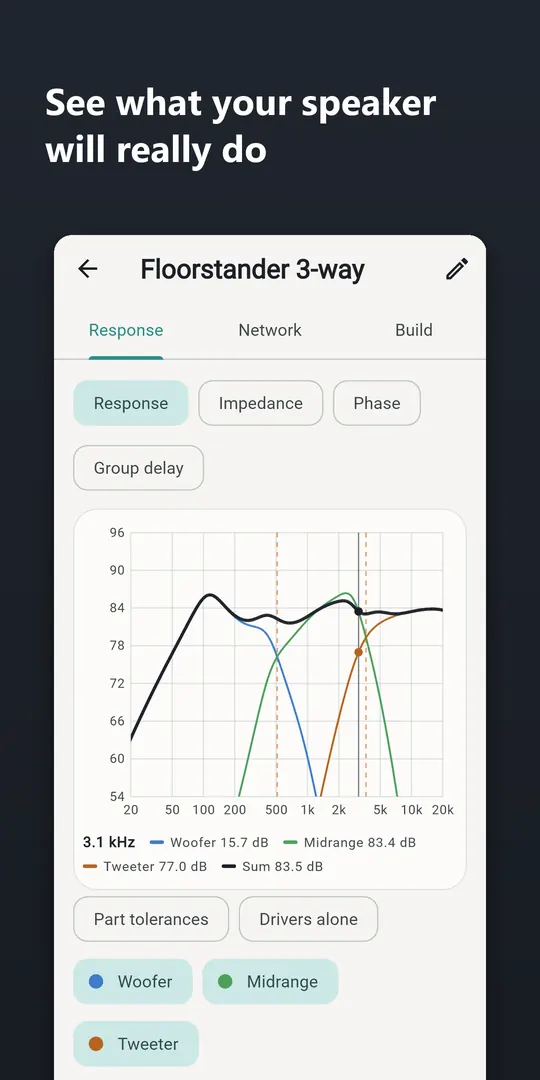
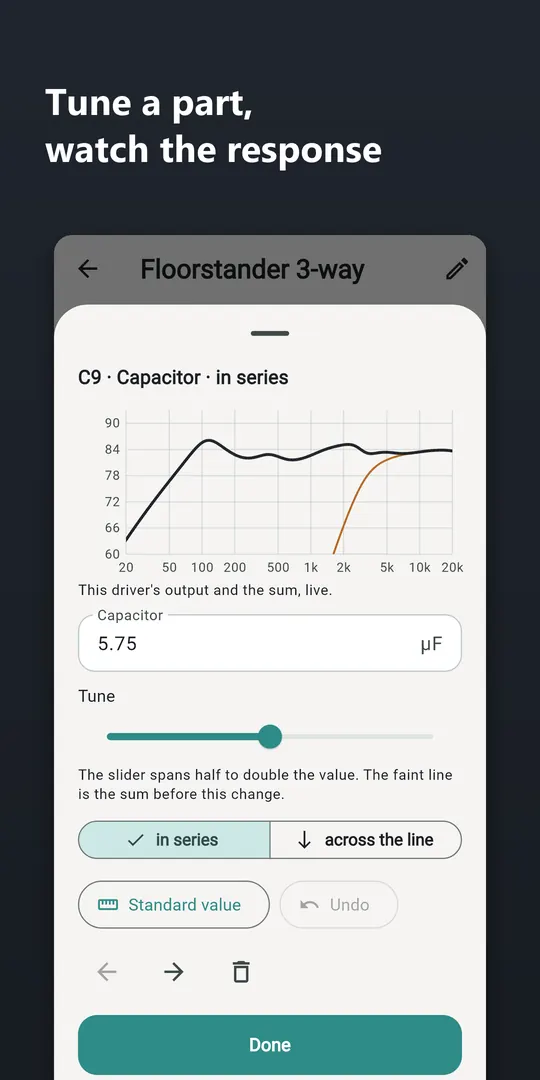
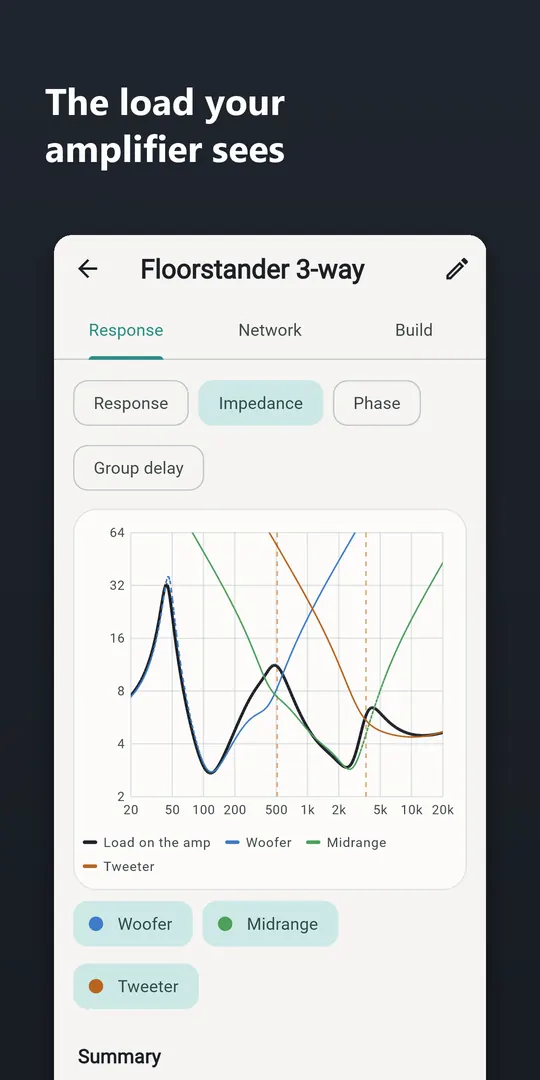
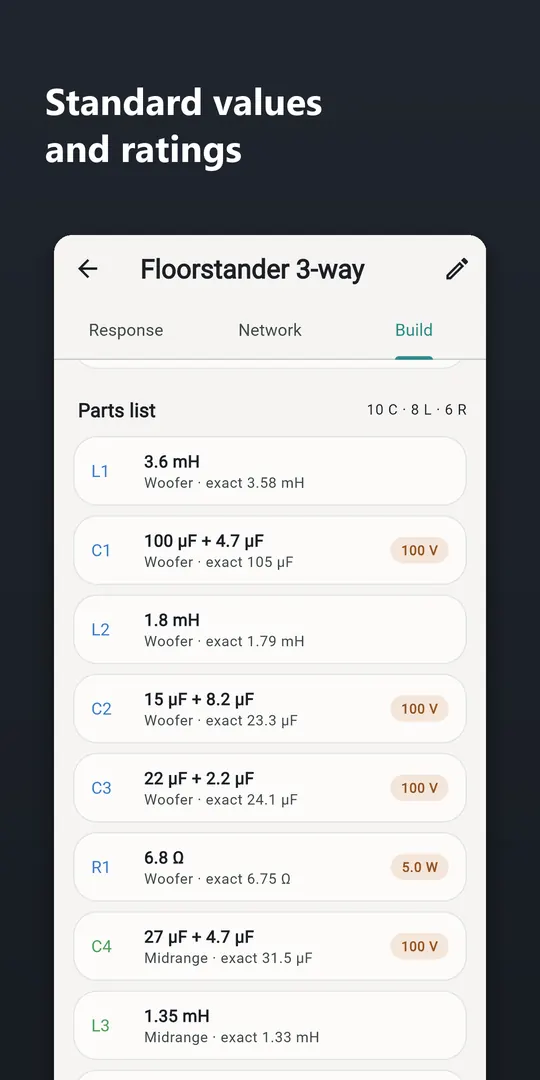
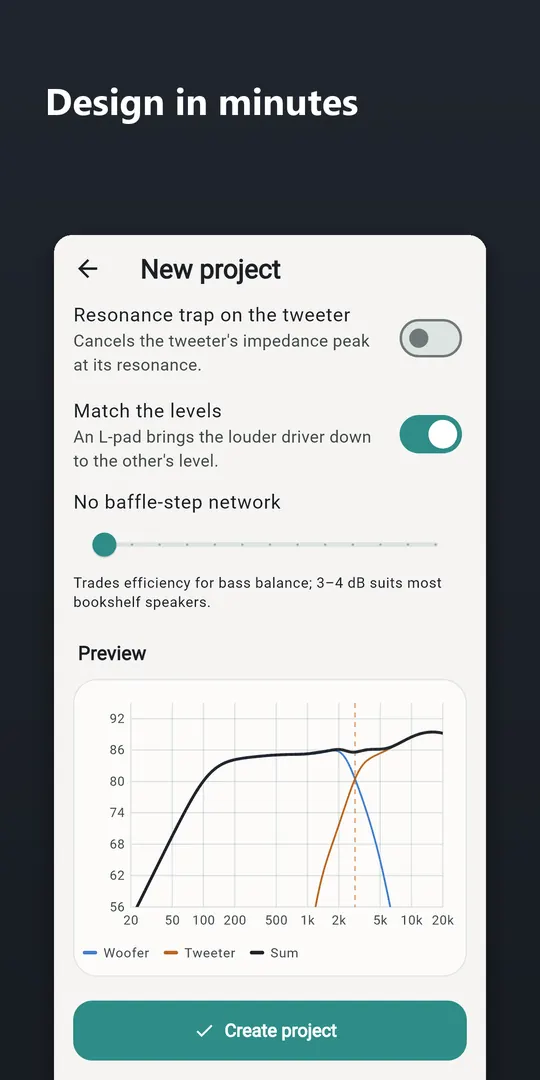
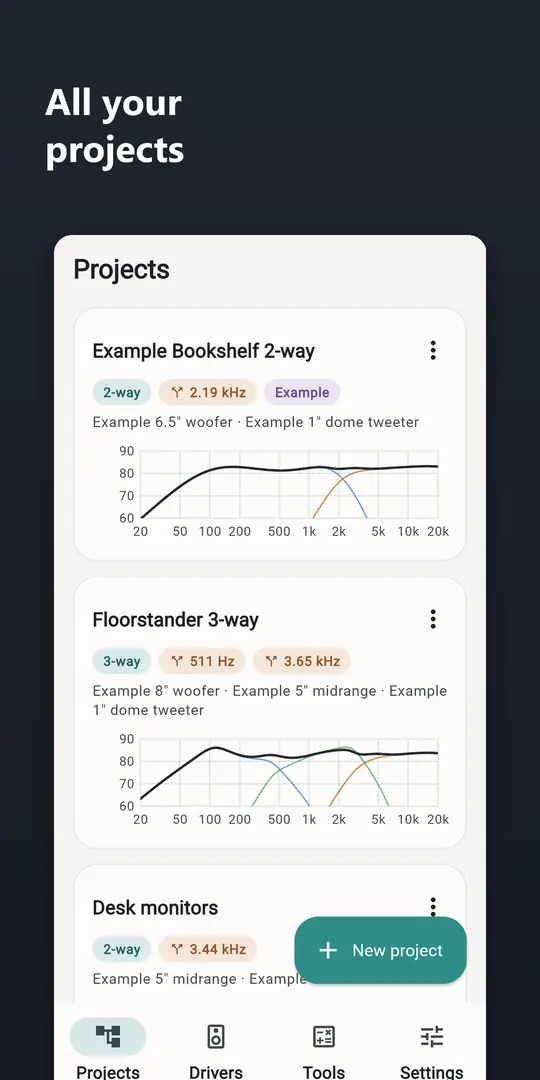
Crossmith in use: the saved crossover projects, a 3-way speaker's summed response with each driver, a capacitor tuned with its slider while the response moves, the parts list with standard values and ratings, and a new 3-way project previewed live.
Crossmith screenshot 1Crossmith screenshot 2Crossmith screenshot 3Crossmith screenshot 4Crossmith screenshot 5Crossmith screenshot 6Crossmith screenshot 7Crossmith screenshot 8

Why we built it

  • Textbook values that ignore the driver's rising impedance, baffle step and phase. Every network is solved against the driver's real impedance, and the outputs are summed with phase, driver depth and height, and the baffle step from your baffle width.
  • Only 4, 8 and 16 ohm, no decimals, and no Linkwitz-Riley or Bessel. Any impedance with decimals, and Butterworth, Linkwitz-Riley, Bessel or a custom Q from 1st to 4th order.
  • An ad after every calculation. No ads on the editor or while tuning; banners stay on list screens, and one purchase removes them.
  • A list of values, then guesswork at the parts shop. Standard values and the best parallel pairs, resistor wattage and capacitor voltage for your amplifier, and a PDF build sheet.

Features

Simulation, not just formulas

  • Summed response with phase: each driver's output through its network, added with polarity, driver depth and height, at your listening distance
  • Impedance the amplifier sees, phase, group delay
  • Baffle step from your baffle width
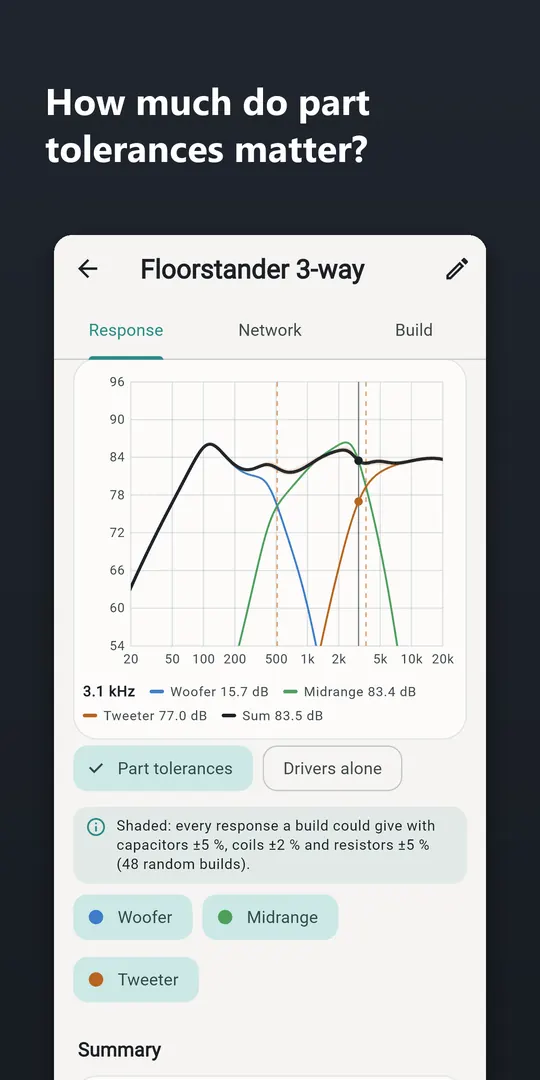
  • Tolerance band: what 5 % capacitors and 2 % coils do to your build
  • Crossover point, phase match, flatness, lowest impedance and warnings in plain words

Design in minutes

  • 1-way, 2-way, 2.5-way and 3-way projects
  • Butterworth, Linkwitz-Riley, Bessel or your own Q, 1st to 4th order (6 to 24 dB/oct)
  • Values designed into each driver's impedance at the crossover, not a nominal 8 ohms
  • Suggested crossover range from the drivers' limits
  • Zobel, resonance trap, L-pad and baffle-step networks in one tap
  • The tweeter is aligned automatically: polarity and a small stagger chosen for the flattest sum

Tune it like on the bench

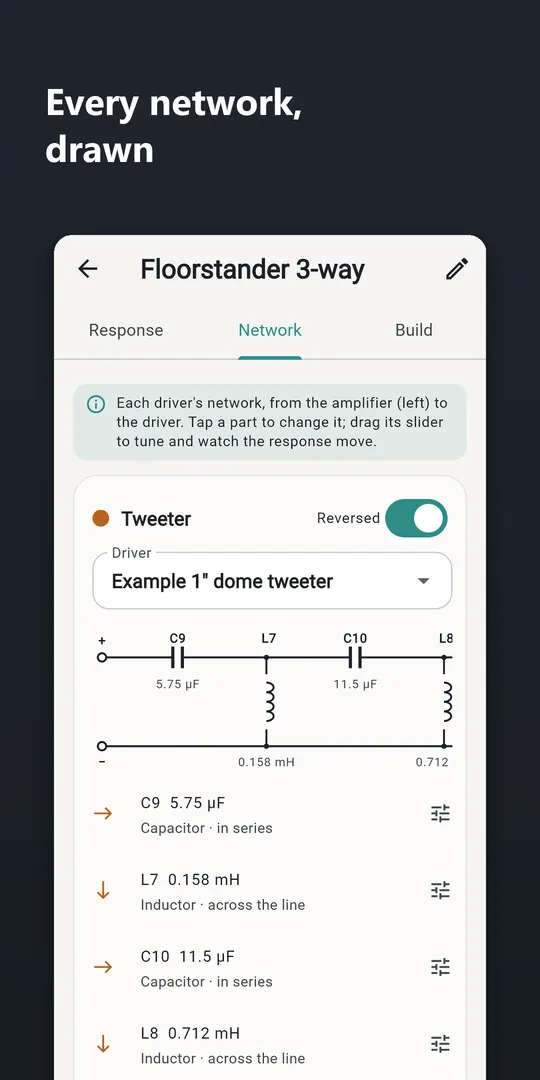
  • Every network drawn as a schematic, from the amplifier to the driver
  • Tap a part, type a value (4,7 uF, 0.62 mH, 3.3 ohm) or drag its slider and watch the response move
  • Any impedance, decimals too: 3.2, 5.5, 16 ohm, whatever your drivers are
  • Coil resistance (DCR) included

Your drivers

  • Start from data-sheet parameters (Re, Le, Fs, Qms, Qes, Vas, box)
  • Import FRD and ZMA measurements from REW, ARTA or a graph tracer; minimum phase rebuilt when needed

Build it

  • Parts list with standard values (E12 / E24) and the best parallel pairs
  • Resistor wattage and capacitor voltage for your amplifier power
  • Build sheet as a PDF, parts list as CSV

Also

  • Calculators: crossover values, Zobel, resonance trap, L-pad, baffle step, standard values
  • Light and dark themes, English, Spanish, Portuguese, German and Italian
  • Backup and restore to a file
  • Ads are kept off the editor; one optional purchase removes them

How it works

Textbook sections are synthesised from their transfer functions (singly terminated LC ladders by continued-fraction expansion), and the tests check them against the published tables: 2nd-order Butterworth at 8 ohm and 3 kHz gives 4.69 uF and 0.600 mH. Every ladder is then solved exactly against the driver's complex impedance at each frequency.

Measured responses without phase get their minimum phase rebuilt from the magnitude on a bilinear-warped grid, accurate to under a degree from 30 Hz to 18 kHz in the tests. Published-parameter drivers are labelled as models: they follow the data sheet's shape, and a measurement is always better.

Honest limits

  • The simulation is as good as the driver data. Models from published parameters are a starting point; measured FRD and ZMA files of your drivers on your baffle are what final designs need.
  • The baffle step uses a simple width rule and ignores edge diffraction ripple and off-axis response.

Questions

Why are my textbook crossover values wrong with real drivers?

Textbook formulas assume the driver is a resistor. A woofer's impedance rises with frequency and a tweeter's peaks at resonance, so the filter's slope and frequency shift. Crossmith designs into the impedance the driver really has at the crossover and simulates the result.

Which crossover type should I use?

Linkwitz-Riley 4th order (24 dB/oct) is the usual starting point: both outputs are in phase and sum flat. Crossmith shows the polarity each type needs and aligns the tweeter for the flattest sum with your drivers.

Can I import measurements from REW?

Yes. Export the frequency response (FRD) and impedance (ZMA) as text and import them for each driver; files without phase get minimum phase rebuilt automatically.

Does it work offline and without an account?

Yes. Everything stays on the phone, and backups are a single file you keep.

Private and offline

Runs entirely on your phone and works offline. No account, no sign-up, and your data stays on your device. The app shows ads through Google AdMob; see the privacy policy. Privacy policy.

Free. An optional one-time purchase removes the ads; nothing is locked and there is no subscription.

More apps from Fernhart Labs

All apps

Boxsmith

Subwoofer box designer with real simulation, port sizing and cut sheets.

On Google PlayLanguages: English, Español, Português

Lugline

Drum tuner that measures every lug and plans the whole kit.

On Google PlayLanguages: English, Español, Português, Italiano

Stringbed

String tension meter for tennis, squash and badminton rackets.

On Google Play

Fair Innings

Fair lineups and rotations for youth baseball and softball coaches.

On Google Play

Sloper Studio

Made-to-measure sewing patterns drafted from your measurements.

On Google PlayLanguages: English, Español, Français, Italiano, Deutsch

Yokecraft

Custom-fit sweater pattern generator: raglan, yoke or drop shoulder.

On Google Play

Crossmith: Speaker Crossover
Passive crossover calculator and simulator: real impedance, phase, parts list.

Coming to Google Play