
Coinfold
U.S. coin album: state quarters, Lincoln cents and every mint mark.
An acoustic timegrapher for mechanical watches and pendulum clocks: rate, amplitude and beat error from the ticks, with a live paper tape.
App languages: English · Deutsch · Français · Italiano · Español · Português · 日本語
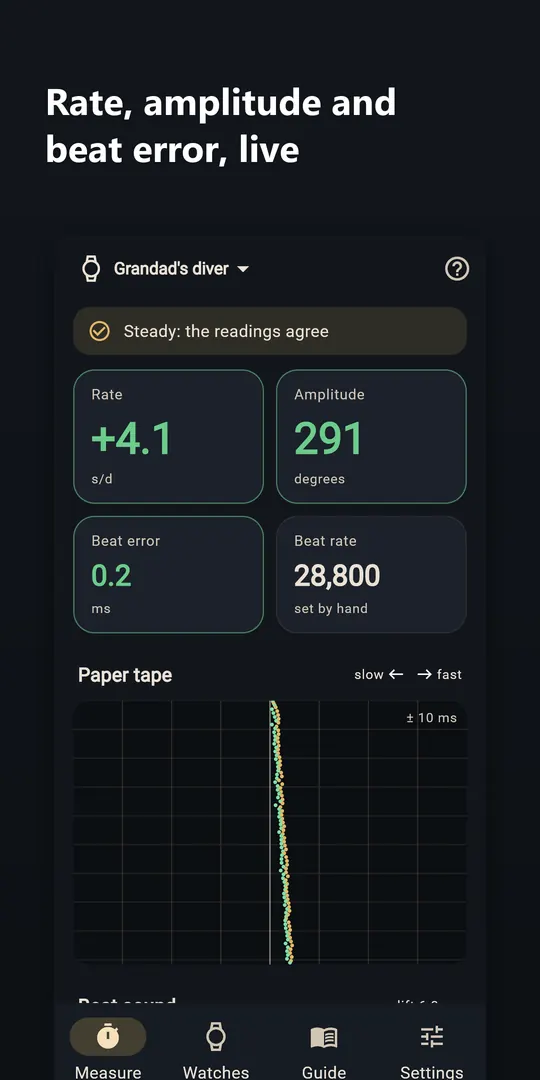
Tickline turns a phone into a timing machine. Lay a mechanical watch on the phone with its crown by the microphone: the app times every beat and shows the rate, the amplitude and the beat error, with a paper tape like a bench timegrapher.
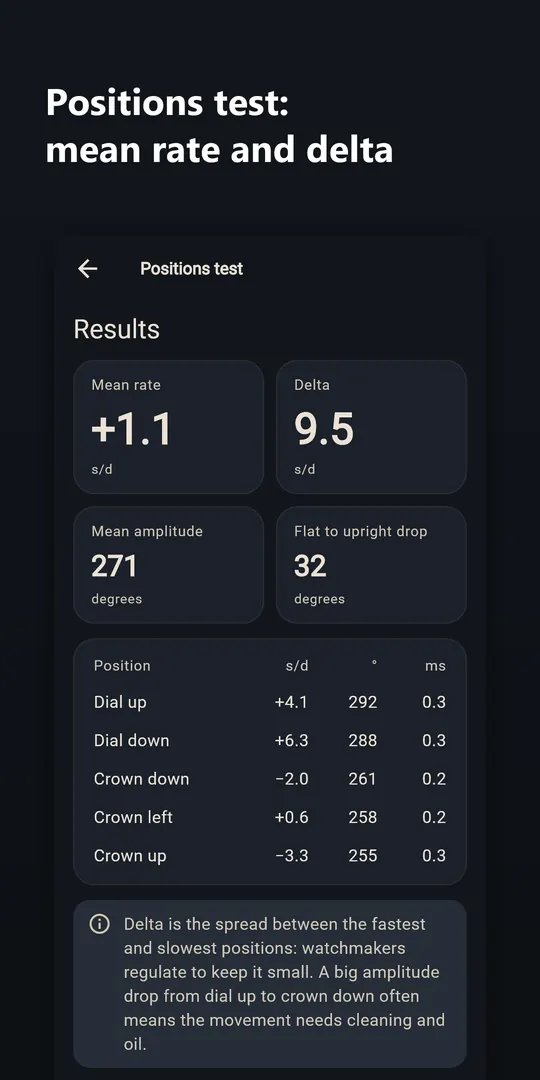
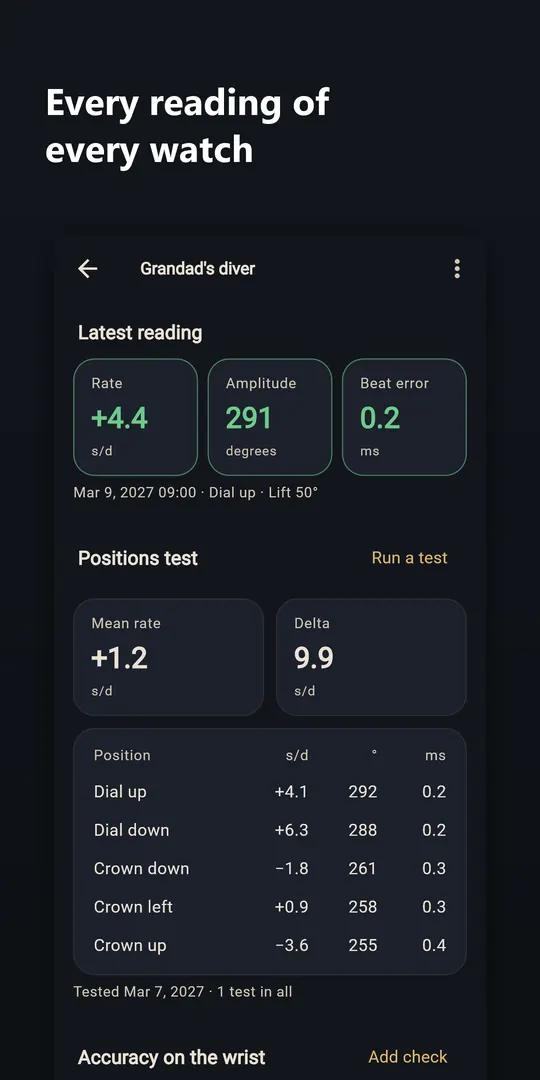
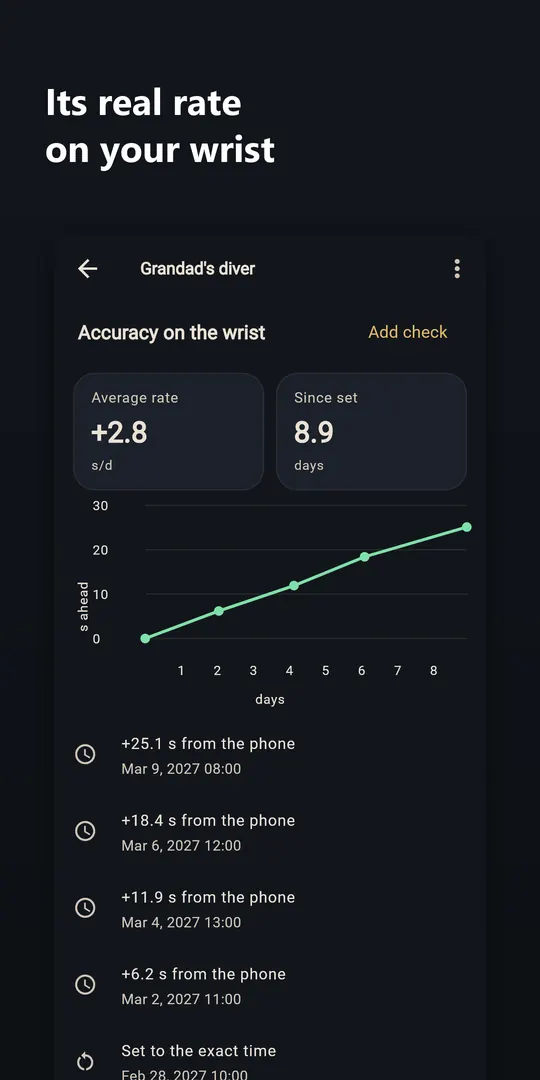
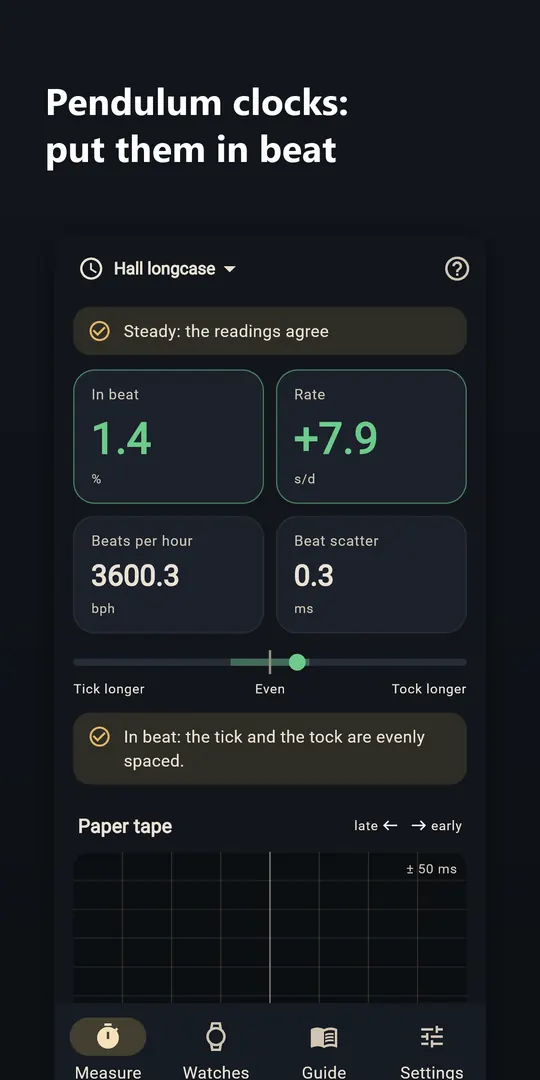
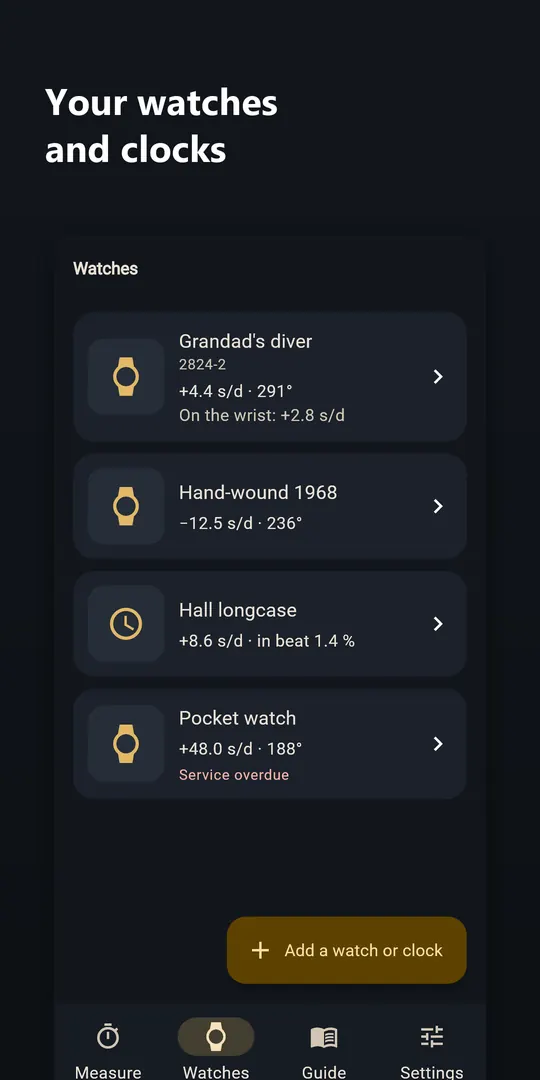
Test the watch in several positions the way a watchmaker does, follow how it keeps time on your wrist over days, and keep a record of every watch and clock you own. Pendulum clocks get an in-beat figure to set them ticking evenly.
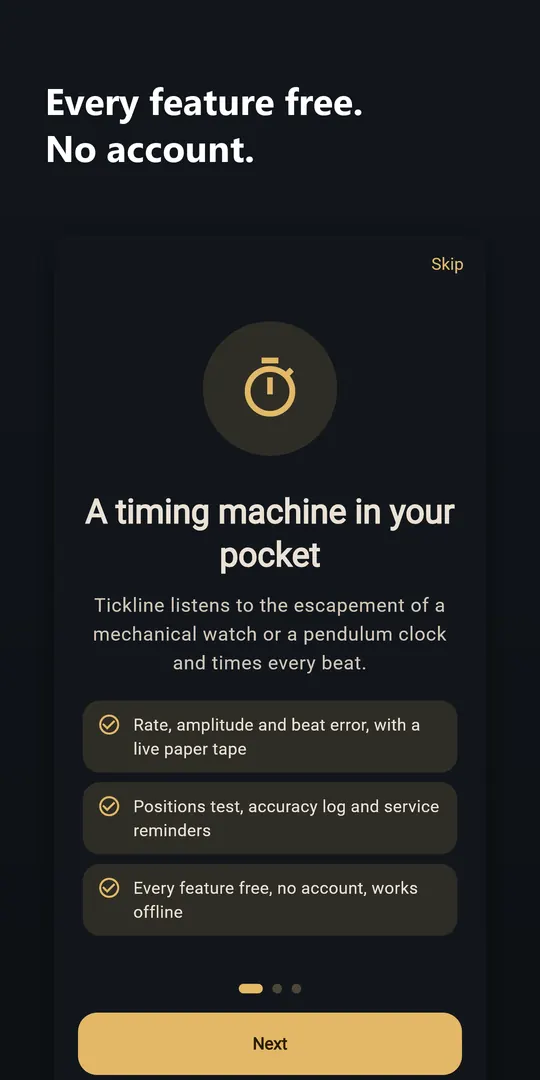
English, German, French, Italian, Spanish, Portuguese and Japanese. Works offline. Sound is analysed on the phone, never recorded or sent. Free with ads, never while measuring; one optional purchase removes them, and every feature stays free either way.
A high-pass filter keeps the escapement's clicks and drops room rumble and voices; a short peak envelope marks each click. The oscillation period (tick plus tock) is found by autocorrelation, checking that half the period also repeats, so half and double rates are rejected; a watch's beat rate is then matched to the standard rates within 2.5 %.
The sound is folded over the oscillation period, which averages every tick and every tock into a clean picture of each. Every beat is then timed by cross-correlation with that picture, within a millisecond of where it should fall, and a robust least-squares fit gives the beat period (the rate) and the offset between tick and tock (the beat error).
In each averaged beat, the first sound (unlocking) and the last (the drop) are found; the balance takes that long to cross its lift angle, so the amplitude is A = LA / (2 sin(pi t / P)), with P the oscillation period, the relation timing machines use.
On 400 synthetic recordings held back from tuning (nine beat rates from 14,400 to 43,200 bph, rate errors up to 400 s/d, beat errors up to 4 ms, amplitudes 170-320 degrees, noise, knocks and room echo), confident readings had a median rate error of 0.14 s/d and a median amplitude error of 0.3 degrees.
Yes, acoustically: the escapement's ticks are loud enough for a phone microphone when the watch lies against the phone in a quiet room. Tickline measures rate, amplitude and beat error from them and shows a paper tape like a bench machine.
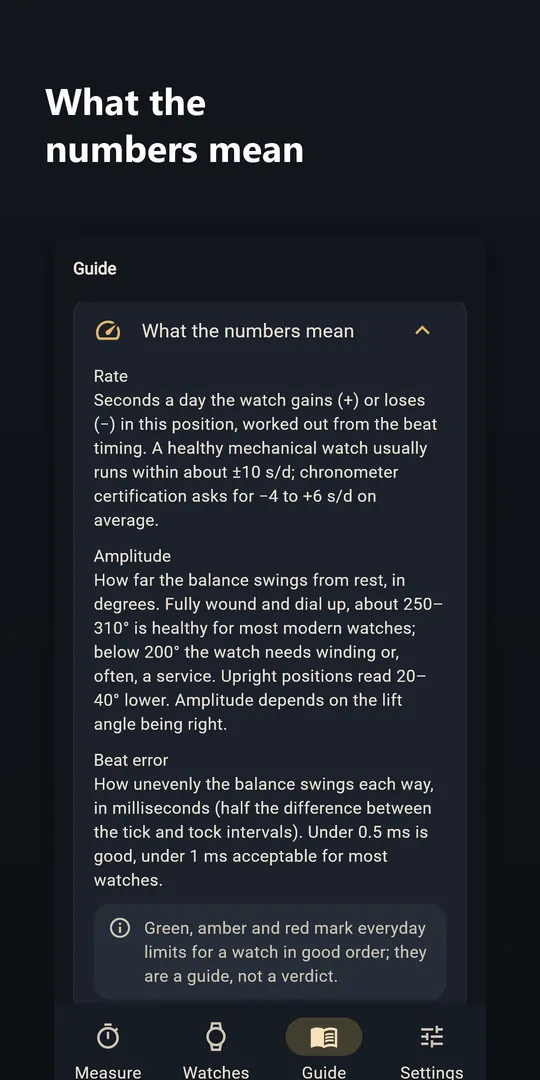
Fully wound and dial up, about 250-310 degrees is healthy for most modern watches. Upright positions read 20-40 degrees lower; below about 200 degrees a watch usually needs winding or a service.
How unevenly the balance swings to each side, in milliseconds: half the difference between the tick and the tock intervals. Under 0.5 ms is good; under 1 ms is acceptable for most watches.
The one in the movement maker's technical document. Most lever movements are close to 52 degrees, which is the default; co-axial escapements are much lower (36-38 degrees). The angle changes the amplitude, not the rate.
A timegrapher measures a few seconds in one position. On the wrist the watch changes position, temperature and wind. Tickline's accuracy log compares the watch with the phone's network time over days to give the real daily rate.
Yes: it shows whether the tick and tock are evenly spaced (in beat), the measured beats per hour, and the rate in seconds per day once you give the nominal beat rate. A calculator gives the beat rate from the wheel train or the pendulum length.
No. A quartz watch steps once a second and its accuracy comes from the crystal; Tickline recognises it and says so. Use the time checks to see how it keeps time.
No. The microphone sound is analysed on the phone and thrown away. There is no account and no server.
Runs entirely on your phone and works offline. No account, no sign-up, and your data stays on your device. The app shows ads through Google AdMob; see the privacy policy. Privacy policy.
Free. An optional one-time purchase removes the ads; nothing is locked and there is no subscription.
U.S. coin album: state quarters, Lincoln cents and every mint mark.

Drum tuner that measures every lug and plans the whole kit.

String tension meter for tennis, squash and badminton rackets.

Fair lineups and rotations for youth baseball and softball coaches.

Made-to-measure sewing patterns drafted from your measurements.

Custom-fit sweater pattern generator: raglan, yoke or drop shoulder.
Tickline: Watch Timegrapher
Watch timegrapher app: rate, amplitude, beat error, positions, accuracy log.