
Quiltsmith: Quilt Designer
A quilt designer that works out every piece to cut and exactly how much fabric to buy.
Coming to Google Play Finished and waiting for its Google Play listing.
What it is
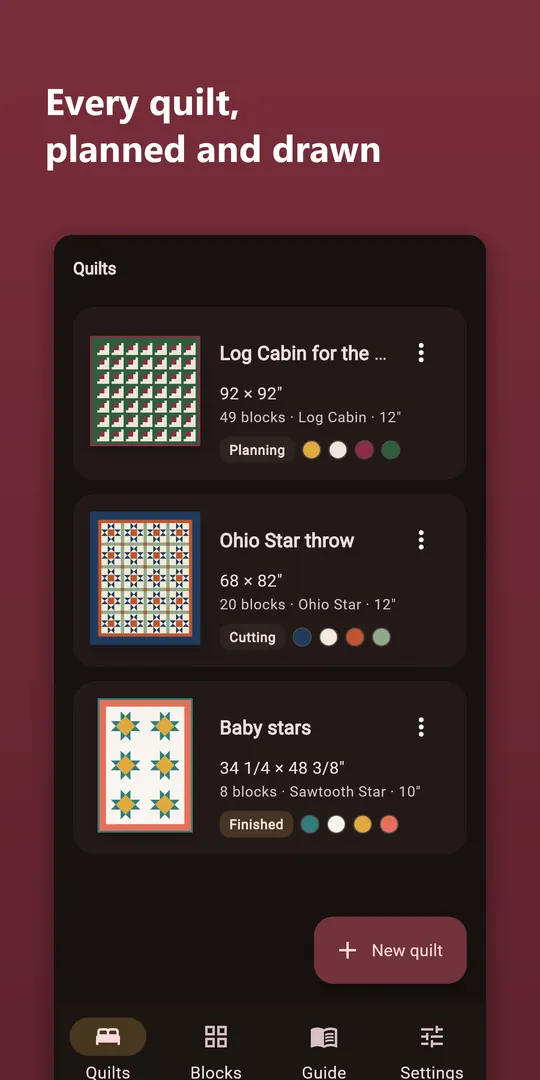
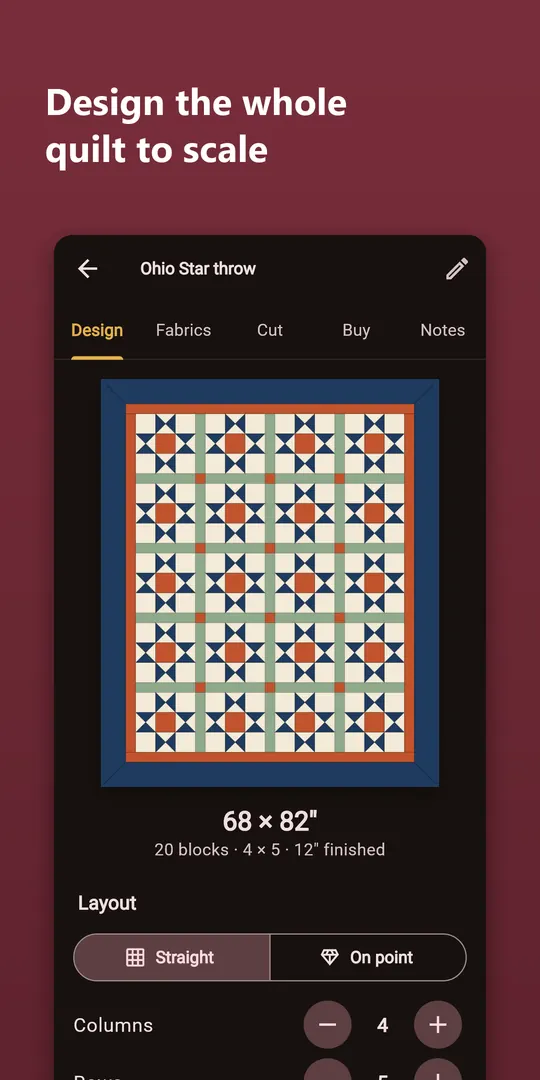
Quiltsmith is a quilt design app and quilting calculator in one. You pick a size and a block, lay out the quilt with sashing, borders and binding, and recolour each fabric to see the quilt drawn to scale.
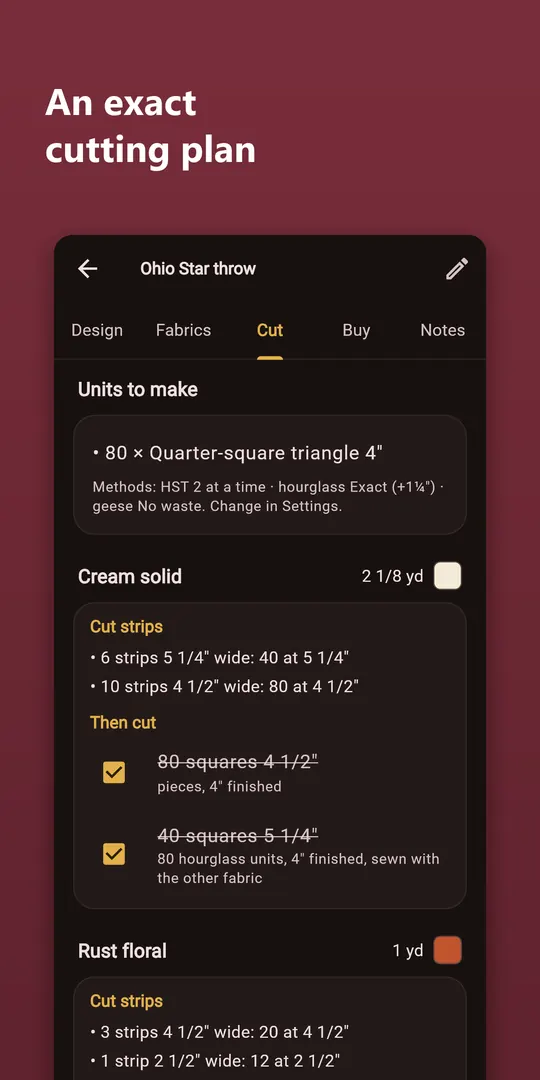
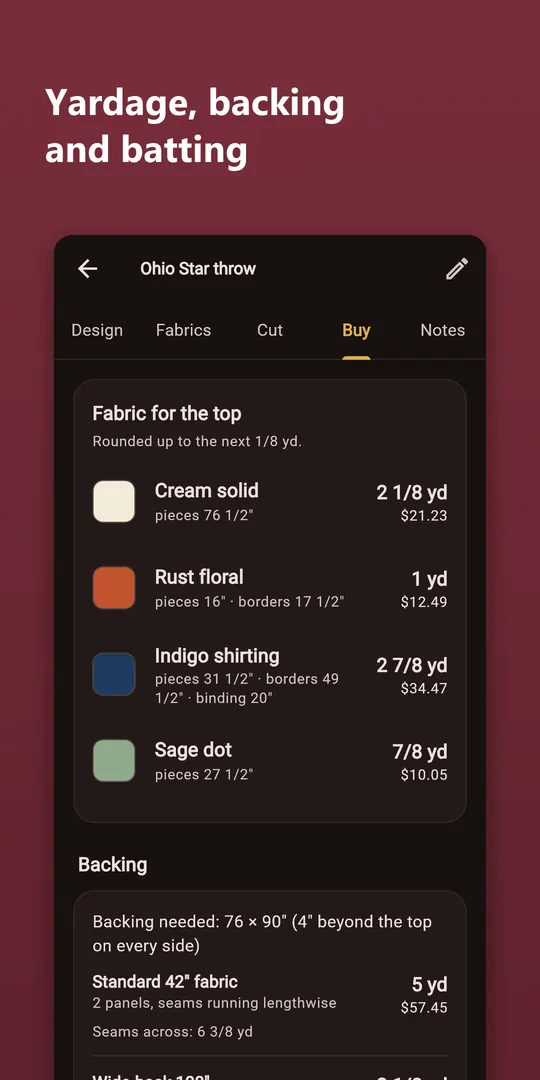
Then it works out what to cut: every piece at its cut size with seam allowances, the strips to cut across the width of fabric, and how much of each fabric to buy, rounded up so you never run short. Backing, batting and binding are included.
Screenshots
Why we built it
- Calculators that only do one piece at a time. Quiltsmith plans the whole quilt: blocks, sashing, setting triangles, borders, binding, backing and batting, from one design.
- Border and binding math that buys too much or too little. Every formula comes from published quilting references and is pinned by worked examples from them; borders, binding and backing are worked out from the finished quilt, not estimated.
- Design tools locked behind a subscription. Everything is free, including your own blocks and the cutting plan. An optional one-time purchase only removes the ads.
- Lost designs after an update. Your quilts and blocks are saved on your phone, with a backup file you can keep anywhere.
Features
Design the whole quilt
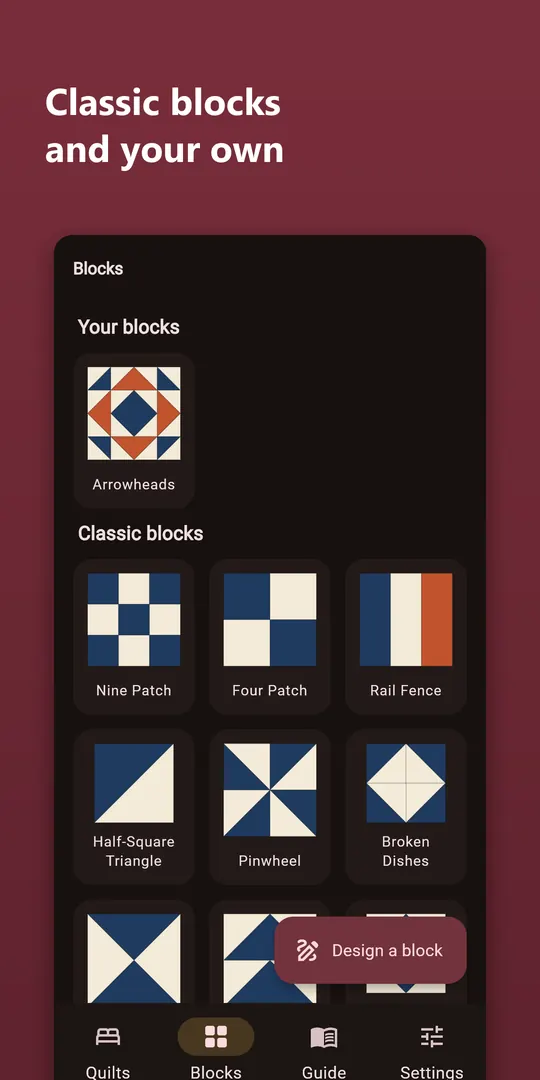
- Classic blocks: Nine Patch, Four Patch, Rail Fence, Half-Square Triangle, Pinwheel, Broken Dishes, Hourglass, Flying Geese, Square in a Square, Friendship Star, Shoo Fly, Churn Dash, Ohio Star, Sawtooth Star, Dutchman's Puzzle, Log Cabin, Courthouse Steps
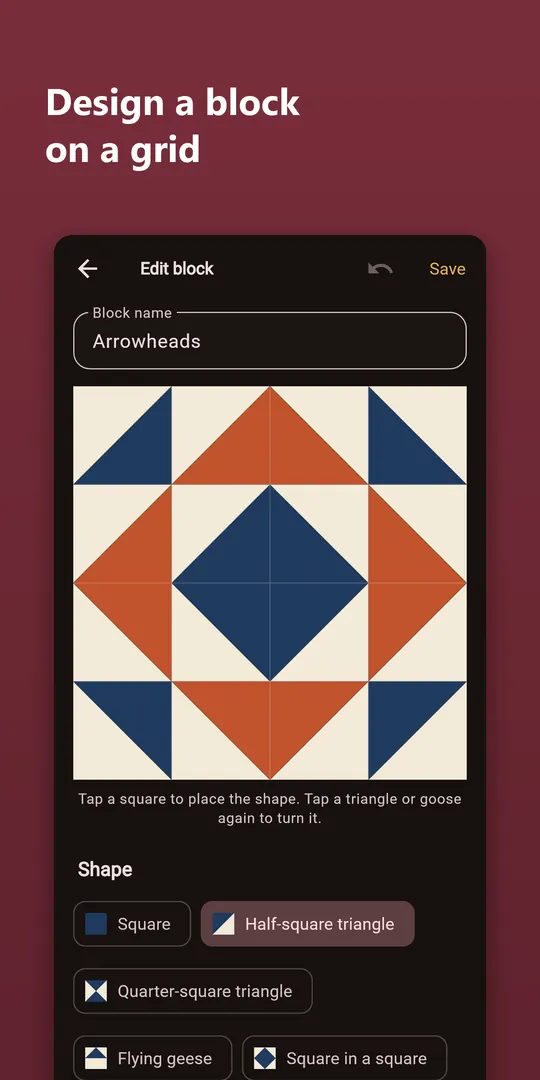
- Design your own block on a grid with squares, half-square triangles, hourglass units, flying geese and square-in-a-square, then use it in any quilt
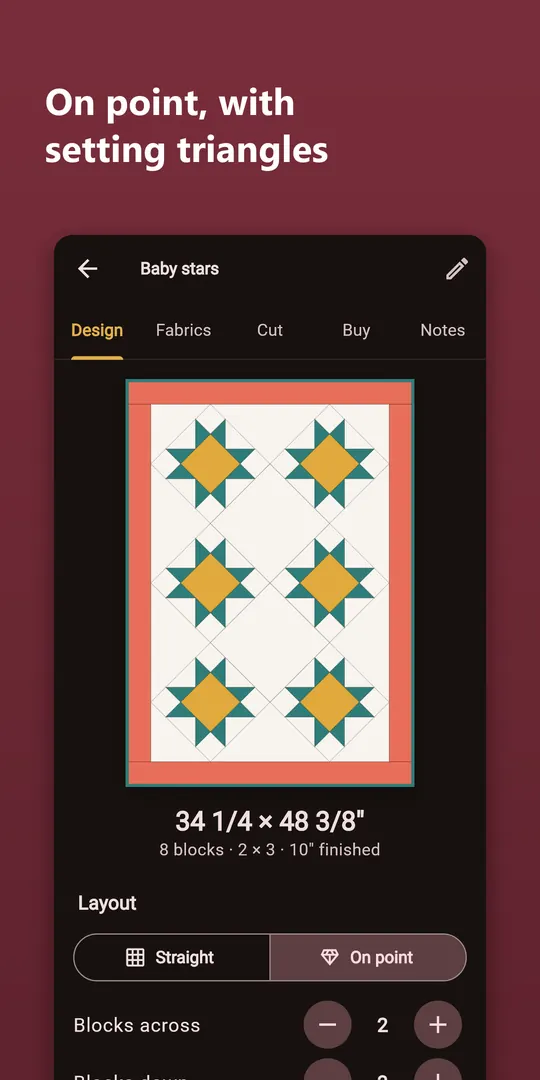
- Straight set or on point with setting triangles; alternate blocks; sashing with cornerstones
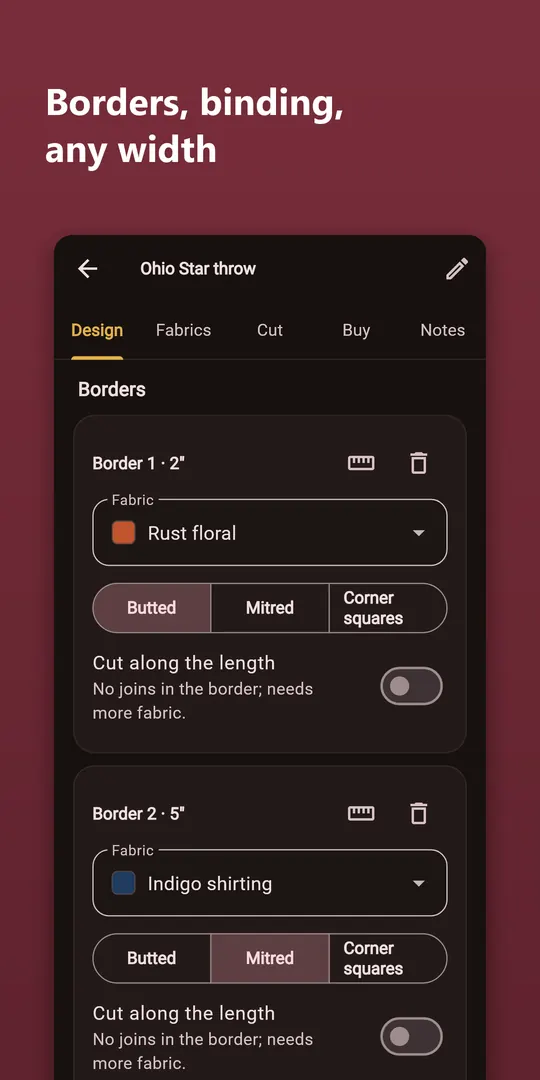
- Borders: as many as you like, with butted, mitred or corner-square corners
- Crib, throw, twin, full, queen and king sizes, or your own; "fit to size" picks the rows and columns
- Recolour every fabric and see the quilt drawn to scale
An exact cutting plan
- Every piece with its cut size, seam allowances included
- Half-square triangles 2 at a time (+7/8") or 8 at a time; hourglass units (+1 1/4"); no-waste or stitch-and-flip flying geese; oversize-and-trim options
- Setting triangles that match the published charts
- Strips planned across the width of fabric, then every subcut
- Tick off each cut as you go
How much fabric to buy
- Yardage per fabric, rounded up to the next 1/8 yard so you never run short
- Fat quarters when they would cover it
- Borders joined or cut along the length
- Binding strips at any width, including 1 1/2", or continuous bias binding
- Backing with the seam direction that needs the least fabric, plus the wide-back amount
- Batting size and the packaged size that covers it
- Add prices for a fabric cost
Take it to the cutting table
- A printable cutting plan PDF with the quilt diagram, units to make, fabrics to buy and the full cutting list
- Share the fabric list to take to the shop
- Notes, recipient, progress and photos for every quilt
Your settings, your way
Free and offline. No account, no subscription, nothing locked. An optional one-time purchase removes the ads.
Quiltsmith, from Fernhart Labs.
- Inches and yards, or centimetres and metres
- Your seam allowance, usable width of fabric, backing width and margins
- The guide explains every formula and where it comes from
How it works
Cut sizes are the finished size plus seam allowances. For a ¼″ seam: squares and rectangles +½″; half-square triangles 2 at a time +7/8″, or 8 at a time from squares 2 × (finished + 7/8″); hourglass units +1¼″; no-waste flying geese from one square at the finished width + 1¼″ and four at the finished height + 7/8″; stitch-and-flip geese from a rectangle +½″ each way. Sizes are rounded up to the next 1/8″ (1 mm in metric).
On-point setting triangles follow the published charts: side triangles (block × 1.414) + 1¼″ cut twice on the diagonal, corner triangles (block ÷ 1.414) + 7/8″ cut once.
Pieces of the same height share strips cut across the width of fabric (40″ usable by default), packed so each strip is used as fully as possible. Strips, borders and binding are added up per fabric and rounded up to the next 1/8 yard.
Binding is the perimeter plus an allowance for joins, divided by the usable width; continuous bias uses a square of side √(length × strip width). Backing is 4″ larger than the top on every side, worked out in both seam directions and as wide-back.
Honest limits
- Blocks are built on a square grid from squares, rectangles, half-square triangles, quarter-square triangles, flying geese and square-in-a-square units; curves, appliqué and paper piecing are not drawn.
- Blocks in a quilt all face the same way; rotated layouts such as Barn Raising for Log Cabin are not drawn yet.
- Fabric is shown as a colour, not a photo of the print.
- Sizes assume accurate seams; the oversize-and-trim methods in Settings add room for trimming.
Questions
What is the best free quilt design app for Android?
Quiltsmith is a free Android quilt designer that lays out the whole quilt from classic blocks or your own, then gives the cutting plan and yardage. It works offline and needs no account or subscription.
How do I calculate fabric yardage for a quilt?
Work out every piece's cut size, group pieces of the same height into strips across the width of fabric (about 40″ usable), add the strips' heights per fabric, add borders and binding, then round up to the next 1/8 yard. Quiltsmith does this for the whole quilt.
What size do I cut squares for half-square triangles?
For two at a time, cut squares at the finished size plus 7/8″: a 3″ finished HST needs 3 7/8″ squares. For eight at a time, cut two squares at 2 × (finished + 7/8″): 7 3/4″ for 3″ units.
How big should setting triangles be for an on-point quilt?
Side triangles: block × 1.414 + 1¼″, rounded up to 1/8″, cut twice on the diagonal; corner triangles: block ÷ 1.414 + 7/8″, cut once. A 12″ block needs 18 1/4″ and 9 3/8″ squares.
How much binding do I need?
Add the quilt's four sides plus about 12″ for joins and the overlap, divide by 40″ and round up: that's the number of strips. A 60 × 72″ quilt needs 276″, so 7 strips of 2½″: 17 1/2″ of fabric, about 1/2 yard.
How much backing fabric do I need?
Backing should be about 4″ larger than the top on every side. A 60 × 80″ top needs 68 × 88″: two 88″ panels of 42″ fabric, about 5 yards, or 68″ of 108″ wide-back.
Does Quiltsmith work in centimetres?
Yes. Switch to centimetres and metres, and the seam allowance, fabric widths and yardage steps change with it.
Can I design my own quilt block?
Yes. Draw a block on a grid with squares, half-square triangles, hourglass units, flying geese and square in a square, then use it in any quilt; its cutting is worked out like the classic blocks.
Private and offline
Runs entirely on your phone and works offline. No account, no sign-up, and your data stays on your device. The app shows ads through Google AdMob; see the privacy policy. Privacy policy.
Free. An optional one-time purchase removes the ads; nothing is locked and there is no subscription.
Coming to Google Play Finished and waiting for its Google Play listing.
More apps from Fernhart Labs
- Sloper Studio — Made-to-measure sewing patterns drafted from your measurements.
- Yokecraft — Custom-fit sweater pattern generator: raglan, yoke or drop shoulder.
- Makerledger — Pricing calculator for handmade goods, with Etsy and craft-fair fees.
- Spoolwise — 3D printer filament inventory, print costs and drying log.