Fernhart Labs.

EN

Platterwise: Turntable Speed

A turntable speed test, wow and flutter meter and alignment kit that puts a ± on each reading and says when one can't be used.

Coming to Google PlayFinished and waiting for its Google Play listing.
  • Free
  • Works offline
  • No account
  • No subscription

App languages: English · Español · Deutsch

Also in: Español · Deutsch

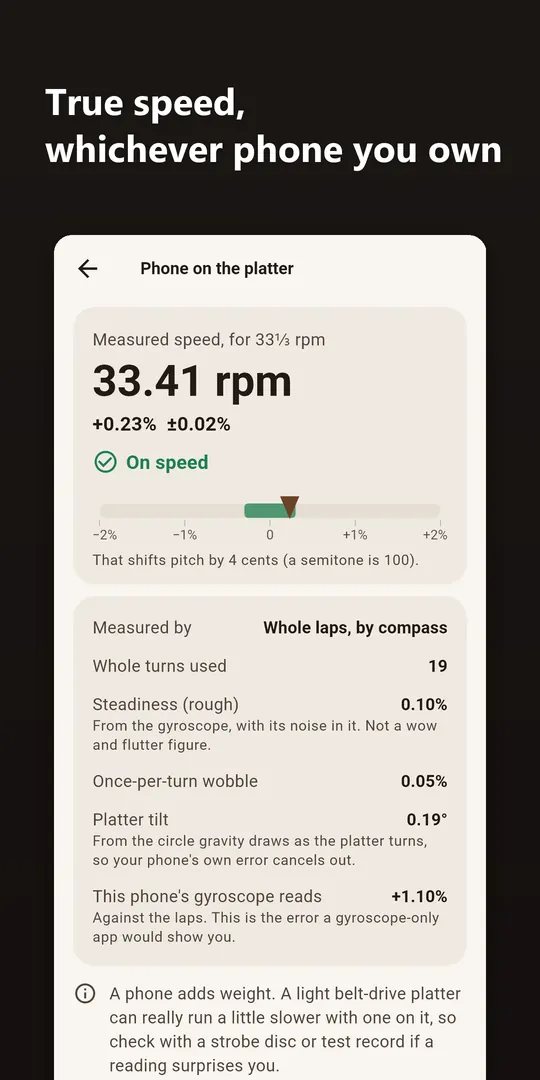
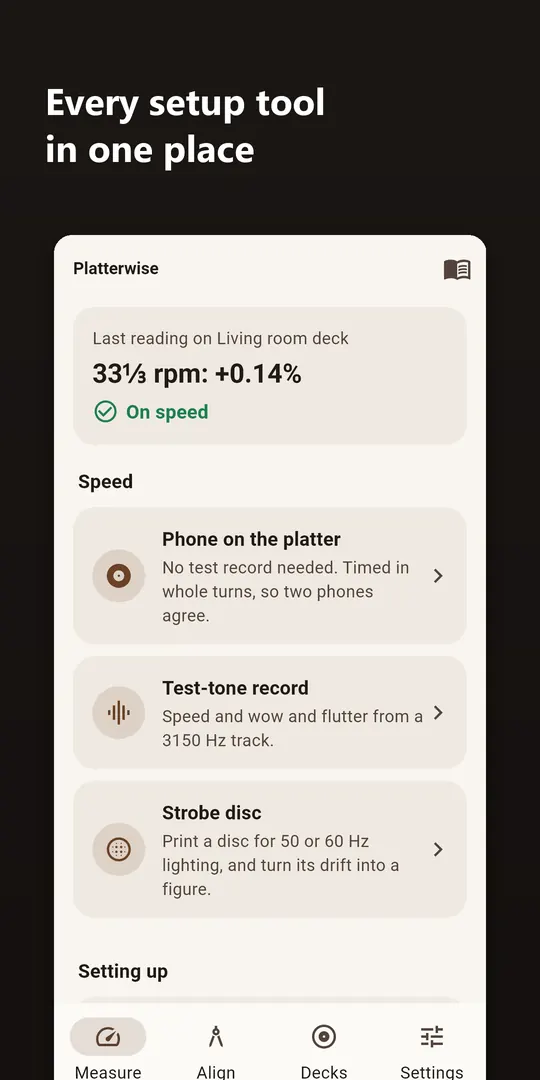
Platterwise helps you set up a turntable with the phone you already have. Put the phone on the platter and it times whole laps with the compass. Play a test-tone record and it reads speed and wow and flutter through the microphone. Print a protractor or a strobe disc when you want to check by eye.

Every reading comes with its margin, and a run that fails its own checks is refused with the reason.

Screenshots

Platterwise screenshot 1Platterwise screenshot 2Platterwise screenshot 3Platterwise screenshot 4Platterwise screenshot 5Platterwise screenshot 6Platterwise screenshot 7Platterwise screenshot 8

Why we built it

  • Two phones on one platter give two answers. Most phone speed apps read the gyroscope, whose scale can be a percent off. Platterwise times whole laps with the compass instead, and uses the gyroscope when the compass can't be used.
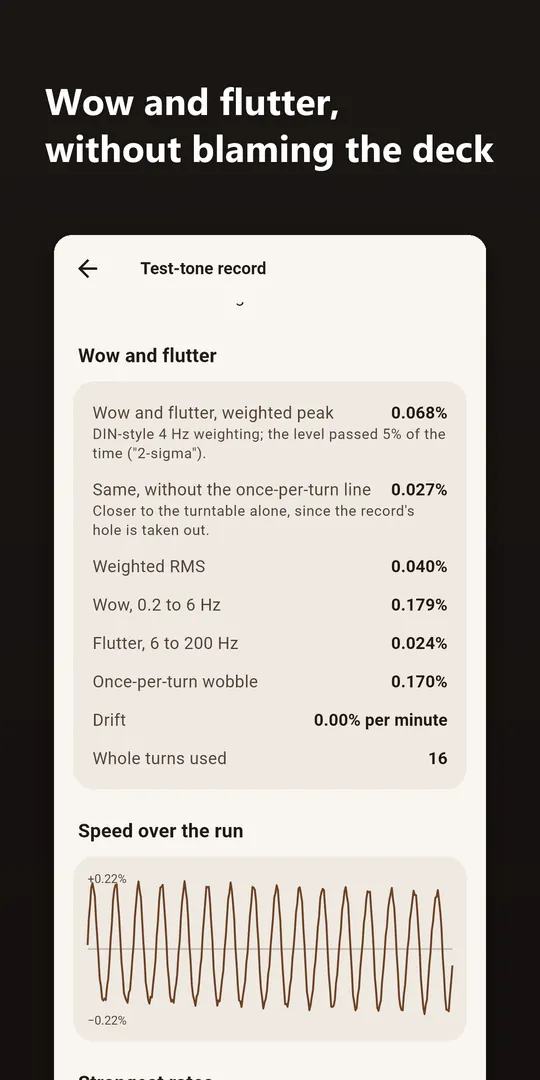
  • A wow and flutter figure with no context. Readings are worded against the record you used, and the wobble from an off-centre record hole is reported apart.
  • Protractors that print at the wrong size. Enter what the 100 mm bars measured and the next PDF corrects for it, on each axis. Then measure the bars again before you use it.
  • A number that hides a bad run. Too much noise, a compass that can't be read, or a run that fails its checks: it says so and shows why.

Features

Speed, three ways

  • Phone on the platter: no test record needed. 33⅓, 45 and 78 rpm, with a ± on every reading. It keeps running while you adjust the pitch, and buzzes when it has enough turns.
  • Test-tone record: speed from a 3150, 3000 or 1000 Hz track through the microphone.
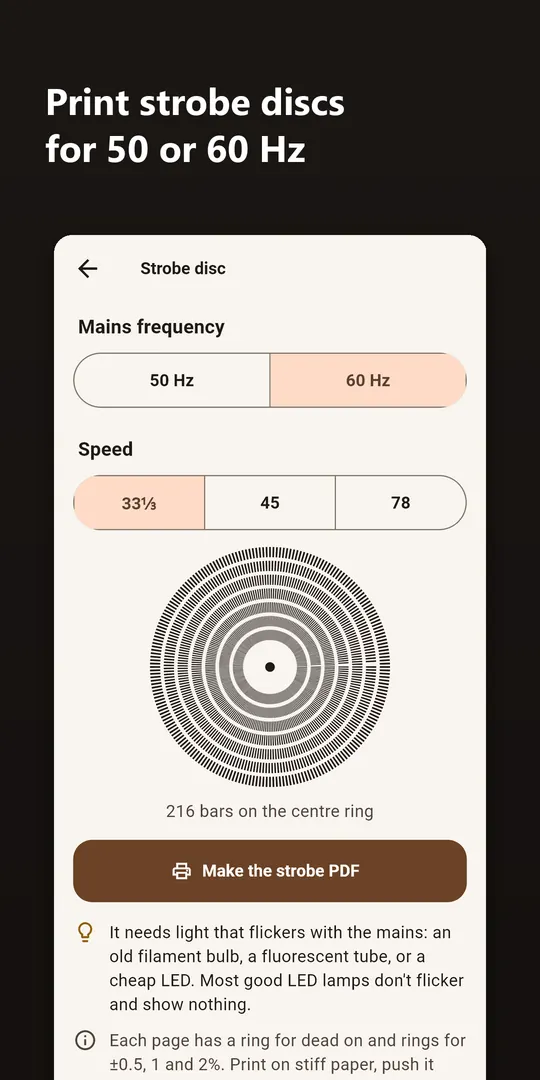
  • Strobe disc: print a disc for 50 or 60 Hz lighting, with rings for dead on and ±0.5, 1 and 2%. Count the drift and it turns that into a figure.

Wow and flutter

  • DIN-style 4 Hz weighted peak, weighted RMS, wow and flutter bands, drift and a speed trace.
  • The strongest rates listed, so you can see what is wobbling.
  • An off-centre record hole is usually the biggest wobble on a test track. Platterwise reports it apart, and shows the weighted figure with it taken out.

Alignment

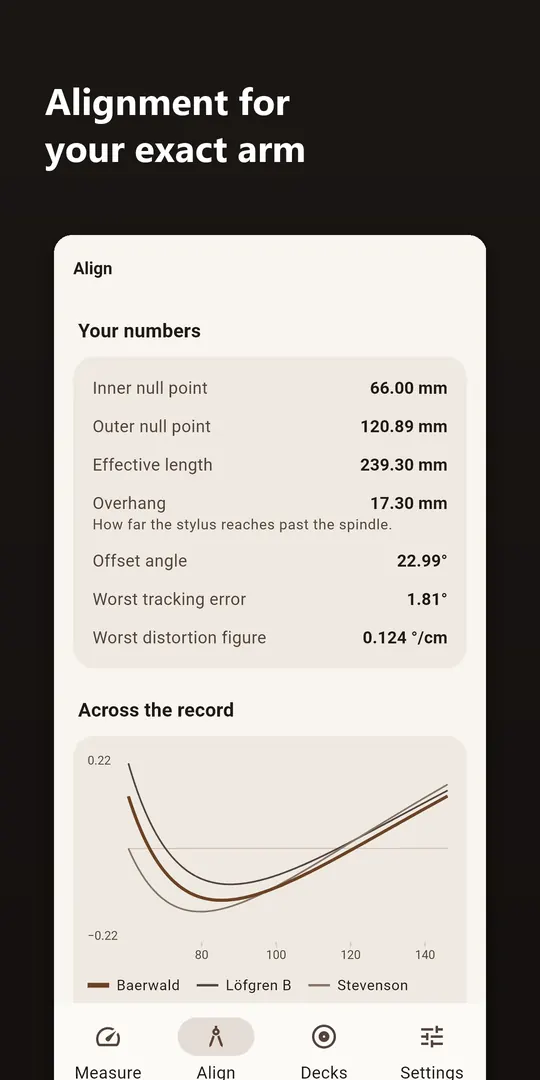
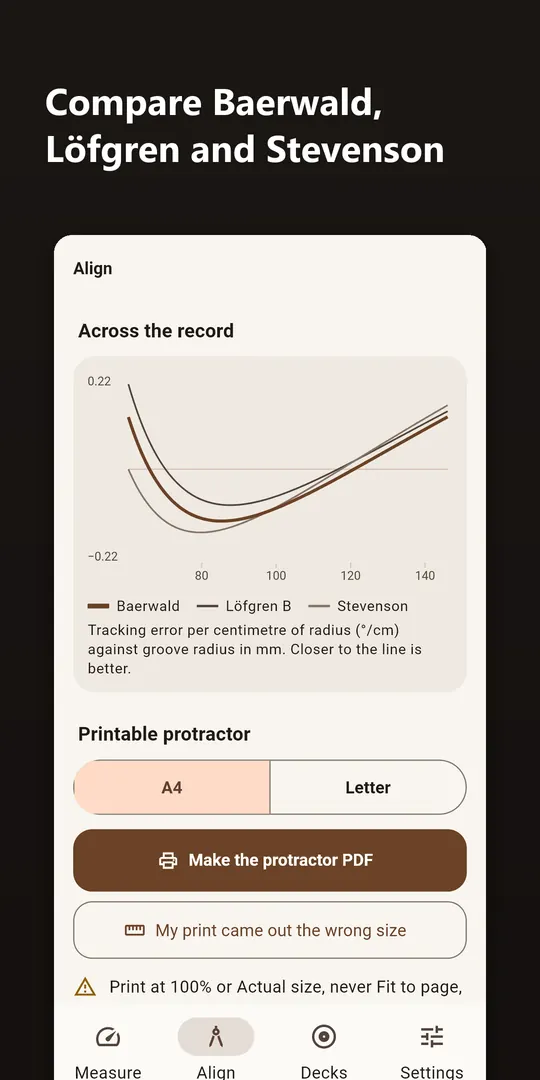
  • Baerwald, Löfgren B and Stevenson for IEC, DIN, JIS or your own groove limits.
  • Null points, overhang, offset angle and tracking error, with curves to compare.
  • Printable arc and two-point protractors drawn for your arm, on A4 or Letter.
  • Your printer got the size wrong? Enter what the 100 mm bars measured and the next PDF corrects for it, even if it scales each way differently. Measure the bars again before you use a printout.
  • Check an arm as it stands from its maker's figures.

Cartridge and setup

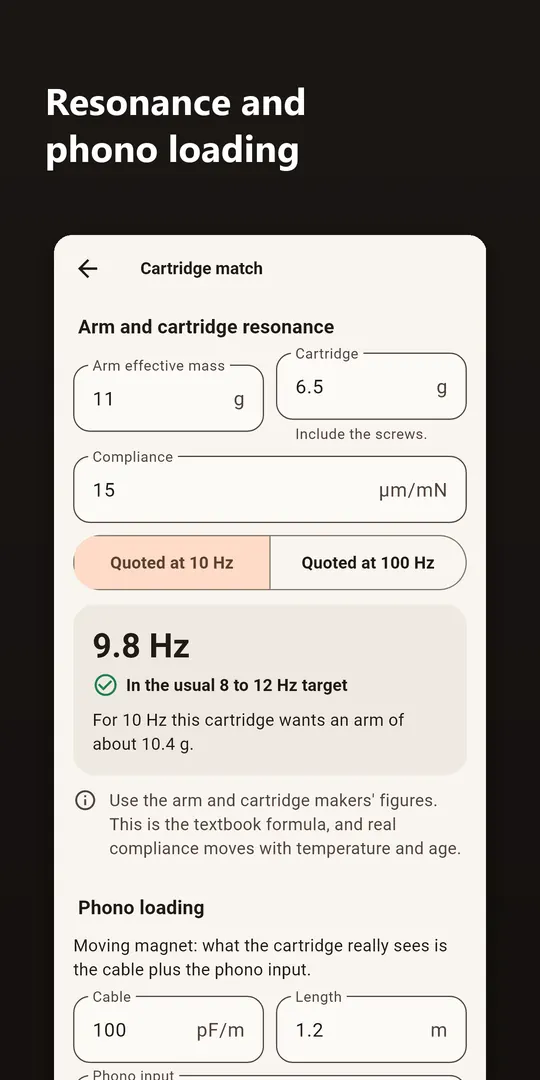
  • Arm and cartridge resonance, with the arm mass your cartridge wants.
  • Phono loading for moving magnet, and step-up transformers for moving coil.
  • A bubble level that allows for your phone's own error, and platter tilt with no calibration.
  • Hum and rumble check: a before-and-after comparison.

A log for each turntable

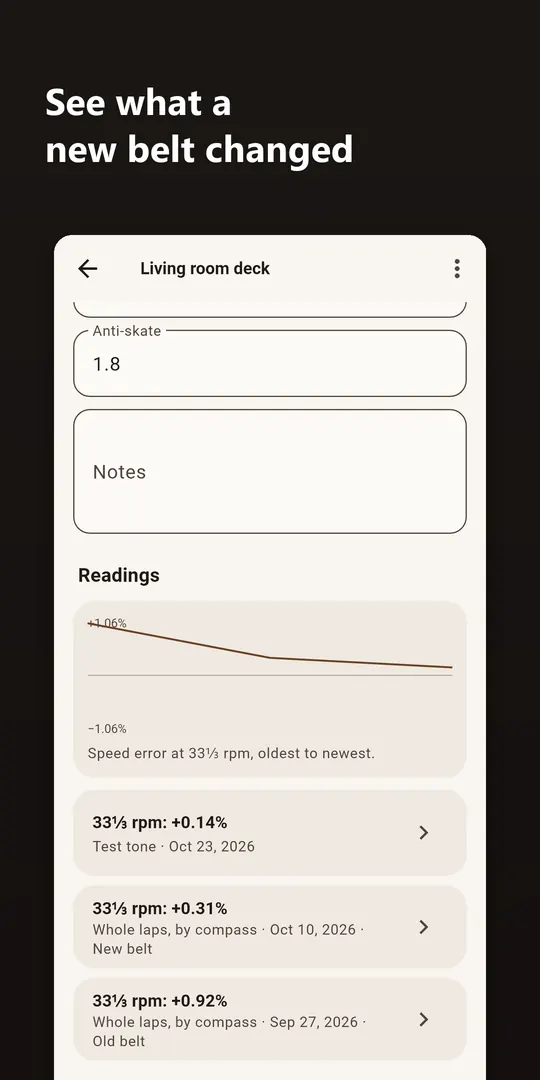
  • Stylus hours, setup notes and every reading, with speed over time.
  • See what a new belt changed. Share a PDF or CSV. Back up to a file.

Straight answers

A phone is a guide, not a calibrated instrument, and results vary by phone, room and record. Platterwise says when a compass reading can't be used, when a tone is too noisy, and when a run failed its own checks, and it shows you why instead of guessing. Test-tone readings are against the record you used.

Your turntables and readings stay on your phone, with no account. The microphone is used only during a tone or hum check, and sound is never recorded to a file. Ads show on the main lists, never while you measure, and an optional one-time purchase removes them.

How it works

On the platter, the phone counts whole turns from the compass and works out speed from how long they take. No test record is needed, and it works on phones with no gyroscope. Steel platters and motor magnets can upset a compass; when that happens the app tells you and uses the gyroscope.

With a test-tone record, it listens to a 3150, 3000 or 1000 Hz track through the microphone and follows how the pitch moves. That gives speed, DIN-style weighted wow and flutter, and a trace you can read.

For alignment, enter your arm's figures and pick Baerwald, Löfgren B or Stevenson. Platterwise draws the null points, overhang and tracking error, and prints protractors for your arm on A4 or Letter.

Honest limits

  • A phone is a guide, not a calibrated instrument. So far these measurements have been tested with simulated signals and scripted sensors, not on every phone, platter and record, so results may differ on yours.
  • Test-tone speed can't be better than the record was cut, and wow and flutter is against the record you used, not a calibrated figure. The weighting curve is the commonly reproduced one.
  • Hum and rumble is a before-and-after comparison, not an absolute level in dB. A printed protractor is only as good as the printout, so always measure its 100 mm bars.

Questions

Can a phone measure turntable speed?

It can give a useful guide. Platterwise times whole laps with the compass or reads a test-tone record, and shows a ± with each reading. Results vary by phone, and a steel platter or motor magnets can upset the compass.

Do I need a test record?

Not for speed: the phone can sit on the platter. Wow and flutter does need a test-tone record, and the result is against that record.

Can I print an alignment protractor?

Yes, arc and two-point protractors for Baerwald, Löfgren B and Stevenson, on A4 or Letter. Measure the 100 mm bars after printing, and enter the result if your printer changed the size.

Does the phone's torch work as a strobe?

No. Android gives no timing guarantee for the torch, so Platterwise prints strobe discs to use under 50 or 60 Hz lighting instead.

Does it record sound?

The microphone is used only during a tone or hum check, and sound is never recorded to a file. Your turntables and readings stay on your phone, with no account.

Private and offline

Runs entirely on your phone and works offline. No account, no sign-up, and your data stays on your device. The app shows ads through Google AdMob; see the privacy policy. Privacy policy.

Free. An optional one-time purchase removes the ads; nothing is locked and there is no subscription.

More apps from Fernhart Labs

All apps

Boxsmith

Subwoofer box designer with real simulation, port sizing and cut sheets.

On Google PlayLanguages: English, Español, Português

Crossmith

Passive crossover calculator and simulator: real impedance, phase, parts list.

On Google PlayLanguages: English, Español, Português, Deutsch, Italiano

Phasewise

Speaker polarity and phase test: compare speakers, see the evidence, no guessing.

On Google PlayLanguages: English, Español, Português, Deutsch, Italiano

Platterwise: Turntable Speed
Turntable speed, wow and flutter, alignment protractors and strobe discs, with the limits shown.

Coming to Google Play